
Today’s reading is Parasha Vayeshev (Genesis 37:1–40:23)
Luke Ford Talks to Greg Johnson
Just Sayin’ you can’t Just Say That
Is this for real?
Donald Trump retweeted three video clips of anti-white Muslim aggression, without comment. Instantly the news cycle was convulsed. Trump’s tweets course through the neural pathways of the system like dopamine.
The outrage seized on the source, a British woman facing jail for speaking against Muslim immigration. Guilt by association always helps to distract from substance. And of what is she guilty? Stuff like the offending tweets, I imagine.
As for the substance of those tweets, there’s always the obscurantist option

Glenn Greenwald might be slipping into millennial-speak when he issues the nonsensical phrase “random Muslims”, but it helps his argument still. He means presumably random acts by Muslims, but there’s nothing random about patterns. These videos are documentary proof of a pattern. They only reach us through the interference of Glenn and his ilk.
(I’m reminded of something I witnessed a few years back. A newly assigned New York Times reporter working in Palestine wrote of her impressions of Palestinians mourning for those killed by Israeli troops. The funerals were outpourings of intense lamentations, but after and beyond that the deaths were taken with a stoicism this western, Jewish woman did not recognize.
The implications were clear, if not to her. A cyber-posse rode out, Glenn and others, I think all Jewish, and she was publicly chastised for the racism of suggesting even a cultural difference between Jews and Palestinians. She quickly pleaded ignorance and apologized. Her impressions were mistaken, coercion made clear to her now.
After this satisfactory conclusion Greenwald observed approvingly “this is how it’s supposed to work.” What “it” is exactly he didn’t say, but I don’t think it’s journalism.)
It is surreal: the Anglo-descended president of the United States roundly denounced by the West’s respectable class for documenting foreigners attacking and humiliating westerners in their home countries. With the vast pozzed middle acquiescing or supporting them. One British luminary promised Trump would be met with massive protests if he dared visit, and he’s to be believed. A vast, motley horde is at the globalists’ command.
“Delete your account” British pols literally demanded, without the customary humor. Indeed, ashen is the only way I can describe the pallor of one horrified luminary who suggested Trump be charged with hate crimes. The elite appears terrified. Trump’s actions are unfathomable.
Trump’s re-tweets constitute a revolutionary act.
As much as it’s rustled the gilded jimmies of our degenerate elite, it may–it has to, one thinks–be giving hope to indigenous British caught between a hostile government and hostile Muslims.

Trump’s intrusion into British domestic politics subverts and betrays the global elite, talking past them to the white populations they loathe and fear. It’s astounding that it’s happening, and that it needs to in the first place.
The progressive order is global, and by its very nature. Opposition tends to be local, by its very nature. Beyond the harried and harassed of the alt right there is no global opposition. Trump may have changed all that. Just the–forgive the phrase–raised consciousness of it could be transformative.
What a global alt right would look like is anyone’s guess. But just the idea of it, widely held, has the potential to accelerate a showdown with the global elite that seems better coming sooner rather than later.
Ross Douthat called Candidate Trump a “traitor to his class” for his economic nationalism. Now he’s a traitor to his time, the Current Year. As for the Brit-pol suggesting Trump could be charged under the same laws as the woman he retweeted, the law is the law. The president isn’t above the law in his home. Why should he be above Britain’s laws? US citizens have been denied visas for political views. Why not the president?
Leonid Bershidsky is a Jewish Russian expatriate journalist who writes opinion for Bloomberg. Here he makes a show of leaving Russia in 2014, citing Putin’s press restrictions and the annexation of Crimea. He’s spent a career in Russian media for a western audience, working for such as the Moscow Times.
The New York Times’ profile of Tony Hovater, “the Nazi Next Door”, went down harsh, from the hard left to the normie middle. Mr Bershidsky offers a chaser:
Tony Hovater, the Ohio man whose profile in The New York Times caused much indignation last weekend, would have been in jail or at least under close police surveillance if he lived in Germany. In the U.S., Hovater is free to keep posting swastika-filled pictures on Facebook — but the writer and editors who published a piece about him that was bleakly neutral in tone face ferocious anger for “normalizing” the Nazi sympathizer.
A certain part of U.S. society’s desire to set rules has been frustrated by the election of Donald Trump as president — though, in fact, it was frustrated even earlier, by years of Republican majorities in Congress. That frustration is manifesting itself as vocal outrage campaigns on the same social networks that have enabled Trump supporters to organize and white supremacists to find like-minded people in other parts of the country. But rather than bring change, the outrage will deepen rifts.
Everyone who’s anyone is angry the Nazi in the story is so nice and harmless–but they would be untroubled in Europe, where he would be thrown in jail for dissent no matter how decent. Bershidsky has the profile of the soulless international bug man, and this piece on its face is a common enough type: an author implicitly suggesting a radical solution in ostensible neutrality. But he goes so far I’m tempted to think it a disguised satire or something. If Bershidsky was alt right, a conspiracy theory of his working for the Deep State to make the movement look ridiculous.
After 1945, Germany chose to pass laws that made most radical right propaganda, as well as Nazi symbols, illegal. These laws are still in force. The Constitutional Protection Office watches people who tend to cut it too close. A tourist who throws a Nazi salute in jest can get arrested. It’s not just swastikas that are banned — schools routinely forbid the wearing the clothes of certain brands that are associated with the neo-Nazi movement. Hate speech against groups of people, including races, is a crime. A vast majority of Germans approves of these rules. Those who don’t — such as members of the far-right NPD party or the most radical elements within the milder Alternative for Germany party — keep quiet about it or run legal risks. Other countries without Germany’s history of Nazi rule — such as Sweden and Switzerland — have also legislated against Nazi symbols.
The standard social-media outrage campaign that quickly brought the NYT to heel is nonetheless waged over media that allows “Trump supporters to organize” and frees “white supremacists” from their isolation. The implied argument here is that social media may have to be sacrificed to social justice. The Left isn’t winning there, but, as the author realizes, the Left was winning before social media’s democratic revolution messed up the program. Social media is a front and fight the powerful don’t need because they run everything outside of it.
I expect nostalgia to kick in eventually, for those simpler times.
A citizen who doesn’t break the law is protected by society as a whole, however immoral his actions. It isn’t writing about Hovater that “normalizes” his behavior; it’s the lack of legal consequences when he embraces Nazi symbolism. Trump’s election, Hovater told New York Times writer Richard Fausset, helped drive that home. He now brushes off attacks with “Yeah, so?”
That’s a mess of a paragraph. I’m not sure how Trump’s election freed Hovater from thinking about criminal sanction. It’s social sanction that has been lifted, slightly, for those with less to risk. What he seems to be getting at here is that social sanction doesn’t cut it anymore, so criminal sanction may be our only recourse. That and not criminalizing a thing is “normalizing” it.
All the outrage campaigns against “normalizing” white nationalism and sexual harassment, two sins of which Trump has been accused, might seem like a call for legislative change. But there is no serious movement for German-style hate speech laws or Nazi symbol bans making their way through Congress. There are no proposals to match this year’s German law that requires social networks to remove hate speech or face steep fines.
But there’s no support for that here. The noise of these daily controversies is just that for the most part. So far the Left hasn’t had to give up its own freedom of expression to silence opposition for the most part, having the socials under their control and applying unashamedly biased policies. But that only goes so far. The Left is losing the Battle of Social Media and may have to call a bomb strike on their own position.
They might not have had to do that if Hillary Clinton had won.
“Research shows that the dynamic that leads to outrage is not the same as that which effects change,” says Ronny Patz, a nongovernmental organization researcher at Munich’s Ludwig Maximilian University. “When such waves, such scandals come into focus, it helps when there’s already a process afoot that matches the outrage.” He means a legislative process, and he’s right. In response to the criticism of Fausset’s piece, The New York Times felt compelled to issue a deftly worded nonapology and to remove from the piece a link to a website selling swastika armbands. But it’s a long way from this kind of damage control to real, lasting change.
Such change would require going through the normal political process: drafting legislation, pushing it through Congress and getting it signed by the president, or overriding his veto. In the U.S., of course, the Supreme Court could also legislate outside this process, as it effectively did with gay marriage — something that wouldn’t work in European countries, where referendums and parliamentary majorities have made the decision.
We have here a chilling vision of what might have been. Hillary Clinton and her Supreme Court instituting controls on speech and media, with a punitive vengeance for our defiance in bringing forth Trump.
Places of our Own
‘For people of color by people of color’
The student newspaper at Evergreen State College has a section in its opinion pages described as “for people of color by people of color.”
“This should be a place where we can be us without it being overshadowed by the dark cloud that is living under white supremacy and having to see things from a white perspective. This is why when we do cover these issues it will be in the context and from the perspective of POC and POC only,” according to the section’s editors as they reintroduced it to readers in September.
The anonymous column, known as “POC Talk,” debuted in the bi-weekly Cooper Point Journal last year and returned this fall to the newspaper’s pages following racial unrest that erupted at the public university this past spring.“Dear White people, please take a step back, this isn’t brown-people-answer-white-people’s-questions-hour, we’re asking specifically for submissions from POC,” the section’s editors added in their September intro. “As being told no seems to be a difficult concept for some of y’all I await your emails about the Irish, how the term white fragility is mean (great example of white fragility) and how we need to view people through a color-blind lens (just lol). You will 100% not get a response!!!”\
Published in the Journal’s Letters Opinion section, POC Talk says it provides “no-holds-barred commentary on local happenings.” In the inaugural POC Talk column, it was suggested that a subject touched on in the column could possibly include “how do I rid myself of white-dread [sic] roommate’s numerous micro-agressions.” Topics the column has discussed include student activism, self care, the local comedy scene as well as the turmoil that upended the college after students in May accused a white biology professor, Bret Weinstein, and the university of perpetuating racism.
The Cooper Point Journal did not respond to multiple requests for comment regarding the column.
This is the same Evergreen College that was being patrolled by a band of lesbians led by a black alpha trannie, all armed with baseball bats, after having shut the school down over some minor offense to their collective pride. Say what you will about the Left, it has the most colorful riff raff. Rightwingers are just embarrassing in comparison.
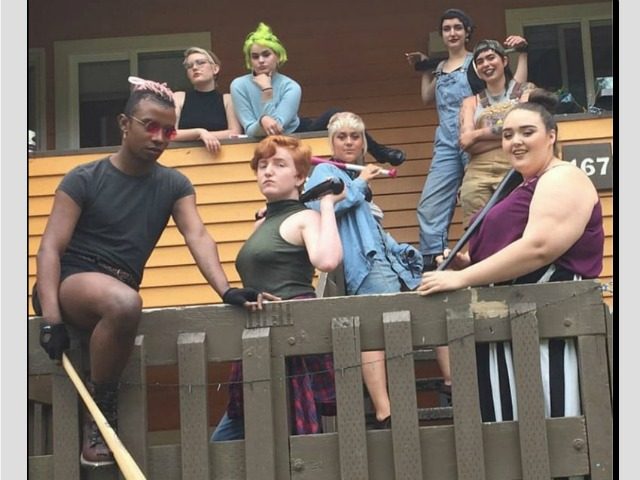
These guys remind me of Orson Welles’ kinky Tijuana street gang in A Touch of Evil. That group featured fifties rock and rollers, a bull dyke and a middle-aged tio with a bad toupee. There is a musical in l’affaire Weinstein if only we can find some gays with both the inclination and willingness to strike this close to their own home.
But home is the thing. Are the kids of color and woe entirely full of it when they lament their status and experience at American universities?
If you leave out the Theory, if you apply the working assumption that rationalization of personal interests is being expressed, however clumsily, by largely self-deluded, immature and mostly unintelligent people who are nonetheless struggling with genuine and powerful emotions–emotions continually aroused by indoctrination–you find something at least honest at the base of it all. And that is the feeling on the part of these kids that they don’t “belong” in an academic environment, that they can’t compete and that its demands are oppressive.
These things are all true. The university is, perhaps, a microcosm of the minority experience in America, with a particular intensity due to the “white” nature of the university–a white invention. There are two ways minority students can feel alienated from this environment, closely related: they are either incapable scholastically because of affirmative action, or the totality of the environment is oppressive and foreign. As oppressive and foreign as the ‘hood would be to the sort of white scholar who thrives in this environment. Because it was literally made for him.
Of course that is changing, by a deliberate process punctuated by the occasional violent whim of students and faculty.
That’s what so much of the racial strife is really about right now. People want to fashion the world to conform to their personal and group desires. Black people have made an awful lot of progress, using musical and athletic ability, to shape America in their image. Jews–unashamed of their ethnicity, unlike their WASP counterparts–determine the way we think, laugh and, largely, act.
There is a difference. Jews don’t feel the need to lobby for “safe spaces”. They simply create them. One could say they’re making of the West one giant safe space for the Jews. Blacks, proud as only they can be of their cultural influence, wage culture as ethnic warfare to great effect. But the same suite of stereotypical traits that make black culture seductive ensure blacks will never master the political or social realms to improve their position. But they have managed to change us. The average pozzed normie is a second-rate black person (or Jew) culturally. The first he accepts like a cuck, the second he isn’t even aware of.
Sometimes I think a lot of this is payback. Someone like Philip Roth is perpetually offended by the foreign nature of his world. Ralph Ellison’s novel Invisible Man transcended the black genre as a tale of the alienation of the man living in an alien and hostile culture. Now it’s you’re turn, Whitey (Goyim).
Having had the “racism” wrung out of us we can barely conceive the thought, much less the language, to consider the possibility that our world is increasingly ill-suited to the individual white because it isn’t his. He laughs at crude black humor because everyone else does. He pretends to “get” thoroughly Jewish stories and themes. Life for him–us–is one long bad evening nodding along to the ramblings of a boor.
He isn’t alone: no individual is suited to a society without a single ethnic and cultural core. Indeed, is there any “society” left in such a society?
The peace of mind of genetic and cultural affinity the minority member must seek in the minority community.
At least he has that. What do you have?
…y luego vinieron a buscar Geraldo…
I speculated yesterday whether Geraldo would fall to the current sexual inquisition for his defense of Matt Lauer, and today Bette Midler, at least, says he should, for an act that was “unseemly” in 1991 (relating a story from the Seventies) and is now a hanging offense.
But most notable is Midler’s referencing the Lauer defense. This is what he’s being punished for; the transgression is cashed in like a chip in the Narrative casino.

Tomorrow is my birthday. I feel like this video was a gift from the universe to me. Geraldo may have apologized for his tweets supporting Matt Lauer, but he has yet to apologize for this. #MeToo pic.twitter.com/TkcolFWfA2— Bette Midler (@BetteMidler) November 30, 2017
I find it difficult to dislike Bette Midler even when she tries. But watching this one has to be struck by the decline in the quality of female celebrities. Even Barbra Walters comes across better than I remember. What happened to genuinely tough (and funny) broads? That’s when women were women.
Older boomers who were adults in the Seventies are compromised as a class by this sudden sexual inquisition. Geraldo wrote a whole book boasting of his sexual escapades. So many out there remain vulnerable, the white ones already undergoing a sort of racial inquisition, with which this one blends seamlessly. The treadmill of white celebrity must be a harrowing experience at the moment. The New Cruelty isn’t impressed.
Midler’s cavalier attitude about Geraldo’s act at the time–and, if true, it is disgraceful–and her bringing it up now reminds me of an earlier celebrity revelation’s journey. MacKenzie Phillips, daughter of Michelle Phillips of sixties folk rock act The Mamas and the Papas, who was in a Seventies sitcom before becoming known as a troubled ex-celebrity and, she asserts, incest survivor, told a story on Howard Stern’s radio program in the Nineties (I heard it; can’t find it) about how, on her eighteenth birthday, she was maneuvered into a room by Mick Jagger, who closed the door behind him and said “I’ve been waiting for this for years.”
She went on to say they spent the night together and it was “pretty terrific.” Her attitude was casual and humorous, someone in recovery boasting of an escapade on the path of excess.
Fast forward to years later and Phillips is promoting her book. I see a clip of her on Oprah. She’s wiping tears away and saying “…and then he said ‘I’ve been waiting for this for years’…”
They’ll never get as far as Mick Jagger though.
Popcorn Purge
Is Geraldo next?

If language is violence “flirty business” is practically a hand wending its way to the proverbial pussy. Geraldo withdrew that hand hastily once he heard the gasp:

If they keep purging they’re going to have quite a little fraternity of the ostracized out there to worry about.
Lake–Oh You Gone
Did Garrison Keeler became the latest and unlikeliest casualty of 2017’s moral panic/political purge because of a defense of Al Franken in the Washington Post he published just yesterday?
Al Franken…did USO tours overseas…the show he did was broad comedy of a sort that goes back to the Middle Ages…If you thought that Al stood outdoors at bases in Iraq and Afghanistan and told stories about small-town life in the Midwest, you were wrong. On the flight home, in a spirit of low comedy, Al ogled Miss Tweeden and pretended to grab her and a picture was taken. Eleven years later, a talk show host in LA, she goes public, and there is talk of resignation. This is pure absurdity, and the atrocity it leads to is a code of public deadliness. No kidding.
The mild Minnesotan hasn’t the energy to defend himself.
“It’s some sort of poetic irony to be knocked off the air by a story, having told so many of them myself, but I’m 75 and don’t have any interest in arguing about this,” he said. “And I cannot in conscience bring danger to a great organization I’ve worked hard for since 1969.”
His decency is genuine, his position untenable. At this stage in the panic/purge the accusations are convictions and the convicted gone in a cloud of dust:
Effective immediately, MPR said, it will no longer distribute and broadcast Mr. Keillor’s remaining programs, “The Writer’s Almanac” and “The Best of A Prairie Home Companion Hosted by Garrison Keillor.”
Keilor cancelled his public appearances, and MPR is moving swiftly to remove his trace:
It will also change the name of American Public Media’s current incarnation of the show, which Chris Thile, a songwriter and mandolinist, took over in October 2016, after Mr. Keillor stepped down.
We’re thisclose to airbrushing people out of photos. In announcing the name change it’s almost as if they’re sending a signal, or rubbing it in at least. In his defense of Franken Keilor ridiculed the practice of renaming things out of political correctness:
My friend Pastor B.D. Christensen said something so good Sunday morning that I woke up and wrote it down: “[something something] . . . about making peace with the mistakes of the past [blah blah blah] and learning from them. It’s slippery ground, in general, to judge past actions by present standards and with a benefit of hindsight that is, morally, highly questionable.”
And immediately I thought about the Minneapolis Park Board voting to rename Lake Calhoun as Lake Bde Maka Ska because the man for whom it was named back in the early 1820s was a slavery enthusiast from South Carolina and an author of the Indian Removal Act and also, judging from his pictures, ugly as a mud fence.
Your critique of the effectiveness of renaming will be taken under consideration Mister…uh…Mis-ter…um…?
But that part about projecting present “standards” onto past acts is interesting–are they standards, exactly, we’re invoking? Because that past, despite its presumed pre-feminist blight, is distinguishable from this one by people old enough to remember as having considerably higher standards.
“I’ve been fired over a story that I think is more interesting and more complicated than the version MPR heard. Most stories are” Keilor lamented. How true. Diversity and feminism are killing us–through the culture. Ever more groups to offend, to placate with unearned representation. Diversity is a web we’re in.
The purge and social justice aren’t interested in “interesting”. They deplore it. That’s a genuine tragedy–the dampening effect of diversity and political correctness on culture, where, just for starters, less and less can be said for greater and greater risk of giving offense.
But Keilor is above all else inoffensive–and liberal. So it makes me think again he’s being punished for that op ed, which may soon be memory-holed along with Keilor. The Post attached this disclaimer to the (now) dangerous and suspect words:
Update, 1:14 p.m. Nov. 29: After we published this column, Minnesota Public Radio announced it was terminating its contracts with Garrison Keillor due to “allegations of his inappropriate behavior with an individual who worked with him.” The Post takes allegations of this kind seriously and is seeking more information about them.
Swiftology and the Doctrine of the Present
The Current Year has been going on for years. The meme goes back to 2015, making that the first year of the Current Year. John Oliver’s fallacy was born of a broader triumphal attitude on the Left following the ascent of Obama–that multiculturalism was irreversible. If the passage of time trumps all for you it’s because you like the way things are going.

Those were the days we measured progress in days.
Then came the Trump “Resistance”, postmodern anarcho-tyranny waged from the recording studios of Hollywood and Manhattan.
Despite nothing material changing since the election, and no real challenge to the cultural hegemony–other than that implied by Trump’s election–the Left pushes for stricter limits on speech and behavior while doubling down on pro-Narrative propaganda. The genuine hysterics mask the totalitarian power grab. We have the first resistance practicing public purges. It’s all very weird.
Having long ago banned too openly “conservative” people from participation in celebrity–yet, somehow, still, Trump!–there is nothing else now but to come for the silent or suspect. Taylor Swift counts as both. But they’d been after her for a long time–since she had the temerity to win one of Beyonce’s awards, at least, but then Kanye only took the stage in outrage because Taylor was so provocatively white a persona in the first place. She was greeted with hostility by black America and artists from the get-go.
Black America adopted her as a white icon long before white nationalists, for the same reasons and without irony.
Swift’s haters are taking advantage of the new, harsher cultural order mandated by the Resistance, to take her down if they can. Trump was their 9/11. The Resistance spawns various versions of the Iraq War, ginned up to milk the mania. One of those campaigns is turned on Swift. Steve Sailer’s law of female journalism is very much in evidence and effect.
(That law, something like “most female journalism is dedicated to creating a world wherein the journalist herself will be considered hotter-looking” should come with the corollary that black women demonstrate the effect with a higher level of intensity.)
Along with this a diverse millennial generation is assuming the establishment media reigns. Salon and Slate have long nurtured the SJW thumbsucker genre, where young writers weave warm coats for their vanity out of critical race theory and the latest Current Year fads.
Being well into the Current Year the fossils of the old establishment are sounding more and more like Slate and Salon. Time and Newsweek, grasping for both solvency and relevance, have adopted critical theory and identity politics fads in analyses and editorials.
(It’s telling that no mainstream outlet yet has even thought of dipping a toe into the alt right perspective; it’s not that they’re leaving money on the table, they don’t even want to know if it’s there.)
So it was perhaps inevitable the Guardian would call out Taylor Swift’s racism in its very own editorial voice, and the tone of that voice now has a hint of up-talk.
In the year since Donald Trump was elected, the entertainment world has been largely united in its disdain for his presidency. But a notable voice has been missing from the chorus: that of Taylor Swift, the world’s biggest pop star. Her silence is striking, highlighting the parallels between the singer and the president: their adept use of social media to foster a diehard support base; their solipsism; their laser focus on the bottom line; their support among the “alt-right”.
Is there a name for the “striking parallel” that isn’t? Even if Trump and Swift were somehow alone in “adept use of social media” (Kim Kardashian is Hitler) it wouldn’t tie them together ideologically.
But what struck me above all was this particle of oblivion:
Swift’s songs echo Mr Trump’s obsession with petty score-settling in their repeated references to her celebrity feuds, or report in painstaking detail on her failed romantic relationships (often, there is crossover). The message is quintessentially Trumpian: everyone is out to get me – but I win anyway. Seeded with clues to the identities of her famous associates, her lyrics reel in and solidify a hardcore fanbase – usually young, female followers known as “Swifties” – who passionately defend her honour on social media by attacking her detractors
As I wrote here before, Swift’s “petty score-settling” is her adoption of the black model of popular music. Indeed, the pettiest and most prominent of those scores is that with Kanye West. Trump always appealed to black rappers especially, before he became a political figure in earnest, precisely for his style, which (you want to bang your head against the wall sometimes) he adopted in some part from black popular culture!
But even Trump didn’t invent the posse of dedicated friends. That too is Harlem, not Queens or Taylor Swift’s Reading, Pennsylvania.
The elite are operating the Megaphone out their ass.
Luke Ford’s Torah Talk with Richard Spencer
Richard Spencer joins us at 47:40
48.20
Luke asks about the recent interrupted NPI conference which Richard describes as a success despite being “ejected from the facility” before they were able to finish.
54.15
Spencer tells about being threatened by Poland’s defense minister and banned from the entire Schengen Zone.
1.14.30
Vivian asks about Faith Goldy, fired from The Rebel for giving an interview to a Daily Stormer linked podcast.
Spencer:”I think we could all kind of sense she had identitarian leanings…I’m not sure I want to make everyone alt right…I have bashed the alt lite but the reason I bash them is because they attack us…but if an alt lite could exist that wouldn’t do that, that could recognize the truth of our movement…but we’re still in the conservative matrix, the normie matrix…when I bash the alt lite I bash these particular individuals I don’t like…”
Vivian asks about Gavin McGinnis “Well, he’s really reaching out to the butt-plug community.” He goes on to defend him somewhat, but he has a low opinion of most of the alt lite.
He’s not impressed with the alt lite: “These people are not our friends — Mike Cernovich, Jack Posobiec, James O’Keefe, Gavin McInnes. They are all these weird personalities. They’re botched people. The Alt Lite is not sending us their best. They are these strange marginal people. They view us as stealing their thunder. They want to be the edgy no-holds-barred Alt Right. The young hip edgy people. I’ve never viewed them as friends. I viewed them as temporary allies in 2016.”
1.32.16
Luke asks about Jason Jorjani.
1.35.25
Luke: “Why are you the face of the alt right?”
“…I was willing to be out front…I was willing to use my face and name…I have been in this for the long haul, I didn’t just jump on this train…I coined the phrase ‘alt right’…if I don’t say so myself I can be charming and charismatic and provocative…”
1.40.30
Luke asks about Greg Johnson. “He’s attacked you fifteen different ways to Sunday…you almost never respond.”
Spencer: “I really don’t like him as a person, I think he is a bad person, I will be perfectly honest. He is a divisive person who thrives on creating internecine disputes…the kind of things he’s done behind my back that are not public that are actually far more poisonous than anything he’s written…using someone as your reverse compass…he seems to desire to take the opposite perspective on me even though he’s clearly wrong…I actually think I’ve been rather polite in what I’ve had to say about him…I don’t think people like that are good for any movement, they thrive on division…”
1.44.00
Luke asks if Andrew Joyce’s essay “Homosexuality and the Alt Right” changed his “views in any way”.
Spencer: “It actually did…I don’t think it fundamentally change Andrew in a way was criticizing people like me who would say ‘we don’t have to talk about the homosexual question’…Joyce actually…did change my views…I was one of those ‘live and let live’ types.”
1.45.10
Luke: “What can the average person who doesn’t want to get exposed do to support your cause?”
Spencer: “…our cause generally needs funds…support what you like, there are a lot of personalities in this movement…I would say sharing our material with friends and family…at the very least not counter-signalling us to friends and family…a lot us in 2016 with the election of Trump I think we kind of got out ahead of our skis…we…were going to be mainstream…we were going to have people working in the Trump administration…come out of the shadows…that didn’t really happen…we did make a major breakthrough…but…can someone come out to their coworkers as being alt right? …no…I think people can be much more useful by being secret agents…not attending conferences actually…if they are someone in a position of power or influence…they probably should not even attend a conference…we’re in this weird space…our movement is part of the mainstream…millions know there’s an alternative…yet we’re still taboo, maybe more taboo…”
1.48.25
Paul Gottfried
1.51.15
Luke asks about Andrew Anglin. “…I’m not quite sure I quite know what to make of him…I would say this to a normie though, ‘look, he is trolling to a large degree but there’s some insight in there as well’…we do fundamentally different things…but I’m also not going to throw him under the bus…I think having a healthy distance between him and me is the best and he’d agree with that…”
1.55.00
The Daily Shoah. “A very down to earth show.”
Regarding the “hail Trump, hail victory” controversy: “I certainly knew how provocative that would be…our movement should be about winning…
1.58.50
I ask Richard the “when did you get woke?” question. “I don’t think there was one moment.”
We talk about eugenics, China, technology. He rejects the rejection of empire. “…we’re going to have to be engaged in determining the world order…little nationalist Poland will be bulldozed…by China or some other major power…we need to rule…if we don’t someone else will…we need to think geopolitically or someone else will dominate us…we are going to have to think about our civilization on a geopolitical level…”
Luke: “Richard, where do you think Hitler was wrong?”
“I would just ask that we table that for a later time.”
The Last White Celebrity
Taylor Swift hasn’t come out and said she’s okay with being white, of course, but she hasn’t explicitly denied it either, and just look at her.
There is something to the coincidence of the “Okay to be White” trolling and the renewed intensity of the anti-Swift movement now. Like the other components of the Left, black advocacy is enlivened and a little manic after the election of Trump. An awful lot of people are taking advantage of that to indulge personal prejudices, such as those against skinny white Beckys for instance.
You have to hand it to Swift. She soldiers on, despite having virtually no defenders in a sub-genre of criticism dedicated to her. Somewhere there is a college course dedicated to her, and not the adulatory sort “studying” Beyonce.
It’s been almost a decade since black America’s campaign against her began in earnest, with Kanye West’s public humiliation of her in an act that would have ruined his career not long before. As it is, he demonstrated a new level of acceptable public racial provocation, which continues to grow in malice.
West’s cultural guerrilla warfare blew out the Overton Window for anti-white animus.
Indeed, black hostility toward Swift tracks Kanye’s periodic acts of hostility toward her, and is subdued but still very evident during periods of Kanye-determined detente, demonstrating the astounding if unacknowledged privilege black America enjoys. Most of Swift’s provocations of the black public come from her responses to West’s random attacks. Swift’s career has become intertwined with his. Every work of hers is scoured for references to him.
Indeed, in her relationship to West and black America Swift is drawn into the black model of popular music based on personal conflicts and self-aggrandizement.
Kanye tested America with his stunt. But the reaction to it–white America’s shrug, corporate America’s indifference, black America’s approval–consecrated the thing. His petty act proved to be of great moment and hastened significantly the present untenable state of anti-white hatred in America.
West’s eventual but complete victory over Swift laid waste to implicit limits on giving offense to whites, as well to as white notions of decorum. He thrived after and by the act, establishing a not just viable but attractive option for others. This has the effect of monetizing anti-white animus.
It was a watershed in the present pilfer-and-appropriate phase of the American civil rights movement. At the same time institutions and culture (and wealth) are being separated from their white progenitors in the name of diversity, blacks seek to banish whites from “black” culture, music, fashion. Other ethnicities follow suit–blacks are the real “model minority”, in that theirs is the political model for racial group advocacy, universally if unevenly adopted (even by “model minority” Asian and South Asians, astutely seeing no need for their prosperity to deny them their share of American ruin).
Diversity is a spider’s web; move this way offend one, move that way offend another. Whites hold still to avoid giving offense. Taking Kanye and his ilk for a joke we are like the man-in-the-burning-room: this is fine.

Even slang becomes proprietary. What’s yours is ours, what’s ours is ours is the present attitude of non-whites, with the vigorous approval of their white allies.
Trump doesn’t challenge black America or its privileged status directly–he seems to accept it–but he challenges a status quo that greatly favors black America. Despite being made up of countless emotional and irrational individual expressions, collectively black resistance to Trump is rational self interest without emotional attachment (or recognition of) a broader national interest.
White spaces are a threat. White faces are a threat.
Where there was condescension for whites as a group safely displaced, if still hanging around and helpfully doing all the work, now there is paranoia. Like the old joke about racist cops finding a criminal conspiracy in three black guys standing on the street corner, any such concentration of whites is a hate crime. The difference of course being the former retains some connection to reality.
The unrealistic characterization of diversity in mainstream media propaganda–and it’s all propaganda now–takes on a whole new urgency. White spaces are now potential hamlets of resistance. Individual whites are potential icons of resistance–as the humorous adoption of Taylor Swift by white nationalists demonstrates.
As with everything else the Left seems incapable of keeping track of the sequence of events. Taylor Swift was made into a figure of white supremacy by blacks for being too white long before Trump and the meme wars.
In advertising, film and television it’s long been standard practice that no group can be too large without the mediating presence of non-whites. There is a number, probably around six, over which no group presented in a television ad, for instance, can be all white. A single family of whites is still allowed (but nearly discouraged, and balanced now by mixed-race families).
There are rules as well for the individual presentation of blacks and whites in media, all bent on portraying the former superior to the latter.
Against the backdrop of reality, where whites risk murder merely by setting foot in black neighborhoods from which occasionally issue raiding bands of murderous orc-like children, in a reality where the limits of black malice appear limited only by that same indulgence we grant Kanye West; in a time when it’s not outrageous to imagine them slaughtering us in the streets if only given the encouragement and means, against these things the ongoing black supremacy kitsch of popular culture is barbaric and sickening.
It can’t be much longer tolerated.
It’s okay to be white. It’s okay to be Taylor Swift.
 untethered