Flashback in the Pan

Dec. 27, 2006

The ferment forms eyes, which turn upon the ferment, in wonder.

I am rising into the atmosphere, looking down upon the earth. Time is accelerating, the earth spinning so fast I can no longer make out its surface. Higher and higher I go into outer space. Momentary flashing irregular pauses reveal successive cycles of decline and rebirth below: ice ages, droughts, floods.
Civilizations are rising and falling, overtaking one another, each building out toward the heavens before falling back to earth to be reclaimed by the soil and buried beneath the crude beginnings of its successor. These strobe-beats are coming so fast now that they resemble an old film. I try to reach back toward the earth, as if to capture it in my grasp; it is only then I realize I have no body.

The sun is dimming, turning red; the earth is cold, inert. All is a flash of blinding, platinum light, searing the eyes, as the dying sun explodes. The light recedes, leaving behind the earth, now a ball of flame trailing the phantom current of the blast. The rate of time’s increase becomes unbearable; I feel it taking me apart, cell by cell, atom by atom. The earth is now a brilliant, orange-red ember glowing in an onyx sea dappled with pin-pricks of starlight. Already it is dimming, fading in concert with my own dissipation: body, sentience, memory, identity, all now indistinguishable as they pass into dust.

The ferment becomes aware, becomes self-aware, seeks to save itself through flight, succumbs and is submerged again in dissolution.
Our lives are futile escape attempts.

Saturday Sermon

No Exit 
(originally published on Dec 11, 2007)

Now that all the groups have disappeared, and every tribe has dispersed, we know ourselves as isolated but similar to each other, and we have lost the desire to unite.
The Possibility of an Island, Michel Houellebecq

Reality is the only word in the English language that should always come in quotes.
—anonymous

Is that you, John Wayne? Is this me?
—“Cowboy,” The Short Timers, Gustav Hasford

Oh the things you’ll see! Oh the Places You’ll Go!
—Dr. Seuss

We arrived at that place, finally. That imagined place where dreams were made real. Dreams of incomprehensible wonder revealing new, miraculous dimensions of imagination. The dreams held us in perpetual, childlike awe. But there we also found nightmares, nightmares we ourselves had released with the dreams. Nightmares at once unimaginable and familiar.

Once released the dreams and nightmares grew beyond our control. They merged and blended, endlessly recombining to create grotesque hybrids, spawning deformed children; all the while growing in number and mass. The sacred and the profane bled into one another until they became one. The sum of every dream became a communal dreamworld, the product of every mind and the product of no single mind.

Art was separated from artist. Meaning was being made meaningless. The people no longer controlled their imagination; it controlled them. The collective consciousness eroded and crowded out the individual. Privacy and solitude were becoming relics of the past. The people were becoming one unindividuated mass, like the inescapable dreamworld they beheld. Yet they were isolated from one another and alienated from the whole.

Every desire, every impulse, every fear and conceit, all vanity, was released to collect in an unintelligible mass overhead, lowering down upon them as it grew. All eyes turned upward, first in wonder and then in despair. Some warned that the dreamworld was displacing the real. But it was no use; there was no returning, and the authorless dreams and nightmares grew and combined as one, crowding out the sky, like a great, gathering storm.

Reality has competition. The virtual and the representational are gaining prominence in the individual and collective psyche, cutting into reality’s market share. “Virtual” reality has even gained practical value. Everything that doesn’t require direct human contact is gradually, inevitably, migrating away from it; economic utility alone ensures this. Engagement with one’s fellows is increasingly unnecessary, and increasingly superfluous. It is now possible for one to survive within and even contribute to society without physically engaging it. For each one of us the necessity of human contact is diminishing. Human interaction is being rendered unnecessary

This fundamental shift is transpiring in a historical blink of the eye–within the span of a single lifetime. The experience of our youth is already antiquated; the world our children will pass on, unimaginable. We are on a path that seems predetermined to end with—or merely pass through—the manipulation of perception at the synaptic level, where experience lives. It is all but certain that we will eventually master the interface between perception and reality. We are not cutting out reality but cutting it off, stranding it. We are not “playing God”, but displacing him. Reality is being made malleable, becoming a mere “social construct.” But “reality” and “nature” are not the same thing. This we forget. Even as reality is coming apart at the seams, nature remains, utterly unchanged and unfazed, as indifferent as ever.

In the future it may come to pass that the individual will have less need for sociality. Evolutionary pressures for it may already be easing. Technology and human vanity combine to ensure that procreation itself will inevitably become a commercialized, streamlined, efficient process, with conception and gestation taking place in vitro and managed by professionals customizing their product for a clientele ordered by wealth; a hierarchy of reproduction intensifying human inequality and its attendant social stratification. Today’s already disingenuous prohibition against eugenics doesn’t stand a chance; it will eventually become a curiosity, if it is to be remembered at all. As for sex, romance and love; their connection to procreation is all but severed; they are now primarily recreational. Family as we know it will pass into history, but the struggle for genetic predominance will continue. It may become a rout as some enjoy unlimited access, and others are shut out entirely.

There is no guarantee that in the future the individual will not select, and be selected for, solitariness. As it is, a growing percentage of the populace is disengaged from and irrelevant to the politics and governance of society. As the average person’s personal liberty grows in the absence of any authority over it, such as by church or community, indeed, as personal liberty becomes the highest virtue, his political autonomy and influence lessens, and he is increasingly irrelevant to a polity he finds confusing, opaque, and unresponsive.

The common man concedes influence in exchange for being left alone; he can count not being pressed into the service of defending the nation or contributing to its welfare or governance beyond paying taxes. He enjoys unprecedented personal liberty and unprecedented social irrelevance. He is left to his amusements; lurid, hyper-lucid and hyper-stimulating (“more real than real”)—sensually and morally deadening. Over the horizon somewhere another class, increasingly alien, works the levers of society and gathers privilege unto itself.

Culture today still retains its partly shamanistic roots—imposing the necessary illusion of order on a natural world fundamentally incomprehensible due to its sheer size and totality; that the human heart can be cordoned off from nature is an ancient dream we still pursue. This fundamental religious belief is what made civilization possible. Absolute truth had to be declared and established before it could be determined (and before we could set out on the path to where we now enjoy the conceit of declaring it nonexisent). Society had to drop anchor somewhere, anywhere, to establish an immutable reference point, to free itself from its primordial drift. But still it is an illusion, and as such it could not last. The illusion has been exposed; we are cut adrift once more.

For the ancients it was the indecipherable chaos of the capricious elements upon which a semblance of order had to be overlaid; a mythology of cause and effect had to be created, and eventually the gods were born. Scientific revelation, in laying bare the patterns underlying the confusion and demystifying the sacred mysteries of sky and stars, incidentally exposed and killed the gods. But nature’s indifference and caprice still haunt us. New mythologies are hastily erected in the form of sociological conceits: ideology, philosophy, social theory and criticism. But they are ad hoc, cobbled together; they fall as rapidly as we put them up. Mystery is no longer the overriding feature of the physical world. Now it is the confusion of a species whose awareness has outstripped its evolutionary pace—that has outrun nature but cannot overcome it. We are still uncovering patterns, still killing gods.

Nature means, literally, everything. Out of necessity we create false layers of remove between ourselves and nature; arbitrary, imaginary divides. But, as with all human artifice, their erosion begins before they are even finished, before they come into being. Nature works upon us even through the very barriers we erect. The clock is always ticking. Human convention is no less a product of nature than anything else, and in nature there is no such thing as permanence. Nature has time we don’t. Literally, all the time in the world. Nature is time. Flux is its only permanent feature.

Meanwhile, we have grown bored with merely manipulating our physical environment. The pace of change has made a mockery of permanence, so we mock and deride the social conventions attempting to preserve a semblance of it, otherwise known as community, habitually. This exposes a lack of confidence. Of faith. Paranoia is imprinted in our genetic code; we sense there’s something else out there. We attempt to give shape and form to this vague fear.

What should be the ultimate practical concern, the physical environment, takes on a religious, millenarian air; mainstream environmentalism prophesies catastrophic wrath to be visited upon us for our sins if we do not admonish ourselves and atone. Alarmed at our very real and apparently boundless hubris, we fashion myths of a vengeful nature wreaking havoc on us and reclaiming the land.

Global warming and AIDS have both become political and social movements predicated on a mythology of hubris and social injustice bringing about catastrophe. But beneath this lurks nothing so much as a profound lack of confidence, not entirely misplaced perhaps, in the ultimate wisdom of human society. Beyond hardcore political activism, the unacknowledged subtext of AIDS as a social phenomenon is the hope, now revealed as hopeless, that the disease would, finally, chasten humanity to temper its headlong descent into sexual immorality and chaos. Remember when “AIDS changed everything”?
Likewise global warming is being invested with the hope that it will spur a revolution in the production of energy, just in time to head off the next global conflict and make a Third World as rich in resources as it is in hostility irrelevant.

In the end, catastrophe mythology is not, as it appears at first glance, misanthropic conceit, but collective vainglory. We give ourselves too much credit. Nature will indeed reclaim the dominion it never really relinquished, but it will have nothing to do with us. We are not even bit players in nature’s tragicomedy, but mere scenery. It is we that we need to keep our eyes on.

Violence permeates the culture, but the reality of daily life for the vast majority is excruciatingly dull in comparison to the alternate reality of cinema and video games. For sensational appeal, it simply cannot compete. The innate aggression and paranoia of the average man is increasingly aroused in inverse proportion to its decreasing necessity.

We have not conquered but insulated ourselves from the physical world, and have begun the logical next step, crafting an alternate reality—a reality manipulable at the individual level. Meanwhile nature still inhabits this false idyll, untold patterns unfolding still. We delude ourselves that nature has been marginalized, finally made small and comprehensible, but we can no more escape her than we can escape ourselves.

In a culture with no center, taken over entirely by commerce, prominence of place is awarded entirely by mass appeal. The vulgar shares space with the formerly sacrosanct. The common cannot be ennobled by its elevation, but its opposite cannot avoid being trivialized by being made common.

Decency cannot survive an order determined by sensationalism. Real life horrors compete for attention with their fictional counterparts. The collective imagination conflates and confuses them. In the end, it all must combine; beauty and ugliness, truth and fiction. In the historical memory they will be indistinguishable. In our minds they nearly are already.

So, what then? I propose no action, no change of course, no return, because these are impossible. There is no going back. It is only for us to gaze in wonder and hold on tight.

Pain and Soros

Soon after the first #blacklives disruption of a campaign event–a double header taking out two white males, Martin O’Malley and Bernie Sanders–speculation arose as to whether Hillary supporter George Soros was behind the hit. This only increased when Bernie was shut down again in Seattle, in front of 12,000.

Then news came Hillary’s secret service agents turned away #blacklives protesters at an appearance. It must be nice to have secret service agents. Bernie had one gouty old Seattle progressive to defend him.

Forget it Jake, it’s social justice now*

So is it proof Soros is not behind the guerrilla tactics? Do I have to discard a perfectly sensible conspiracy theory? Thankfully, no; the Astroturf Amazons telegraphed their moves, then conveniently failed to execute them:

The group had initially told The New Republic that they had planned to interrupt Clinton’s event and ask her about her drug platform, and campaign staffers inside the room were aware of those intentions due to the magazine’s publication.

Because the former secretary of state and first lady has Secret Service protection, her events are typically sealed once she enters the building — and the group of activists apparently did not make it to the event by that time. They were standing under a tent outside the school doors as the event began, but eventually made it into the building to watch in the side room.

Hillary gets a “Hillary meets with protesters” headline and Bernie gets “Sanders humiliated by girls.” I can still smell bullshit. It’s playing out now as if the point isn’t to take down Sanders, but for Hillary to curry favor with blacks. Oh if only the Republicans were a serious party, capable of and willing to field a serious candidate to run on a law and order, implicitly pro-white platform. The scary thing is their biggest fear of that is that it might succeed.

*important note to SJWs headed to Ferguson and other social justice hotspots: “Bulletproof, Black Lives Matter” tee is not actually bulletproof. It is, however, 100 percent cotton and available for just 28 dollars!
But again: not bulletproof.

Gettin’ Paid

The meek passivity with which the white Left has absorbed the aggressive entitlement of “black lives” wreckers harassing the Sanders campaign (the socialist has real-life counter-revolutionary wreckers, but he can’t say it!) reveals a new stage in the ever-evolving Democratic coalition of the fringes.
Addicted to black outrage, the party is compelled to adopt an organizational model similar to the Mafia, where a dominant individual or “family” commands a percentage of all criminal activity in a given domain. The black faction (which is not to say black Democrats but everyone involved in black advocacy, including Soros the consilgiere manipulating a clueless, volatile godfather) is the crime boss and nothing goes down in the boss’ territory without his approval–and nobody so much as sells a dime bag without the boss getting his taste. That’s why you don’t say “all lives matter”–you’re cutting out the rightful originator of the grift.

Old Bernie was just getting the held-by-his-ankles-out-the-window treatment to remind him to whom he must “kick up”.

The Importance of Legacy

From Steve Sailer:

ABN comments

I get the sense that there is a lot of psychic stress experienced by the Talented Tenth, i.e. bourgeois middle-class blacks like Ta-Nahesi Coates. They basically live among white people according to white norms, but this creates in them a need to “keep it real” by defending and excusing the dysfunction of underclass blacks. It’s like how the most anti-colonial element of society in the former European empires was the Westernized native elite rather than traditionalist tribal elders.  

 In a saner world, the Talented Tenth would have an aristocratic attitude of protective paternalism toward black proles, in the spirit of Booker Washington. In actuality, black ethnocentrism, despite being a fundamentally conservative trait, gets filtered through the ideology of the white liberals who run post-white America. 

So instead of straightforward tribal noblesse oblige, gentry blacks like TNC (and Obama) live by the fundamentally dishonest and passive-aggressive code of leftism: all animals are equal, but some animals are more equal than others. They lie that D’Shawntavious is their social equal, and the implausibility of that claim means they have to lie again by claiming that Whitey is a wrecker. I actually kind of pity middle-class blacks who wish to be champions of their people even as they operate within an ideological framework created by leftists who despise their own people.

But the Talented Tenth patronizes its people as vociferously as any elite group and is probably less alienated from its poor relations than, say, Wasps before they undertook the Great Cuckolding. Whatever doubts the Tenth is capable of regarding defense of the murderous and the mediocre, it appears they are lessening over time along with the credibility of their arguments and theories, and are easily and readily sublimated into political action that, coming full circle, has become largely about translating black failure into political power. Failure, fed through enforced faith in the equality of the races, is black political power. The black elite and their white allies love black failure, even if they don’t know it.

The Tenth is unique among elites in that their legacy has become suffering, and they hold fast to that legacy because it’s invaluable–the perception that black Americans have suffered uniquely among peoples has them dominating politics and culture; not despite a history of failure but because of it. It’s the greatest con ever. Combined with black dominance in culture and sports, it has this population hitting above its weight like no other. By “weight” of course I mean its contribution to the commonweal.

Conventional thinking on race doesn’t exaggerate the problem, it inverts it. Reverse the arrow of causation, reverse the arrow of moral responsibility. The uneasy Left senses this. It isn’t that white America cannot honor its debt to blacks because the sins are too profound, it’s that black America can’t honor its end of the bargain–to become peaceful and productive–due to a lack of human capital and will. Anchored to a moralistic fallacy–black intellectual inferiority is unthinkable ergo impossible–we can only go down, and we do, scrambling to define deviancy down and adapt mores to accommodate black behavior.

It’s also a proven political model, adopted to all manner of newcomers; black failure is the gift that keeps on giving. Some angry, Suge Knight type guy should be fuming through his cigar right now over how the brothers aren’t getting paid for this.

Fraught and Bothered

Steve Sailer contextualizes an Atlantic Monthly blog post as “historical racism porn”:

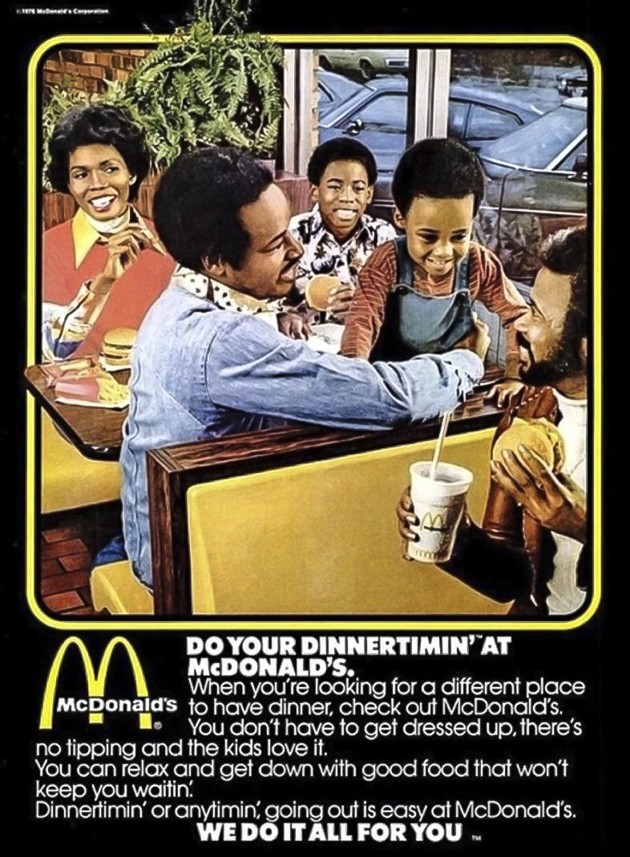
‘Dinnertimin’ and ‘No Tipping’: How Advertisers Targeted Black Consumers in the 1970s
In an attempt to reach African American customers, many U.S. businesses began integrating their commercials—often by relying on fraught stereotypes…
 
[ I call this one Kid with Big Forehead advances on Richard Pryor’s Big Mac as Proud Parents look on]
SJW’s have been getting hot and bothered over this ad that ran in Ebony and Jet in August 1976 for the last three years. NPR’s CodeSwitch responded to this ad in 2014 with:

The Atlantic blog post is good but the NPR link is a better demonstration of a certain style rapidly becoming familiar, as social justice scribes chase links by providing various types of outrage porn; all confidence on one side, listing and categorizing transgressions like Tracy Flick reporting on someone in middle school, and on the other all obliviousness to anything not indulging the Narrative. The NPR blogger tries his best to put a comedic spin on the old point-and-sputter, but social justice just isn’t funny.

What, McDonald’s, implying they’re all his kids? 

White privilege views the oppressed person of color asleep–safely inert–dreaming 
only of eating the oppressor’s poisonous food before the daily exploitation of his labor!

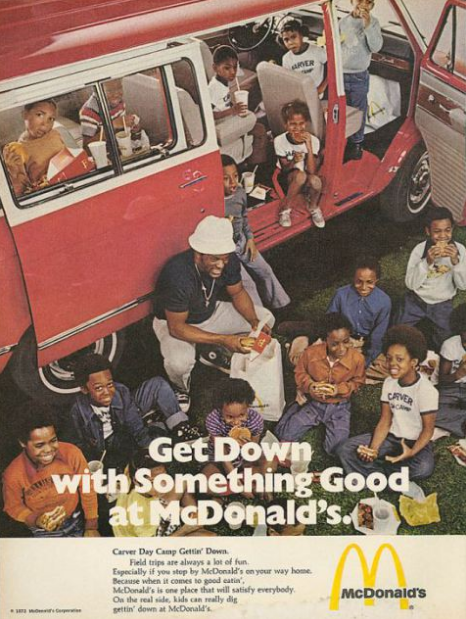
The black ads condescend toward their black targets in pretty much the same way white ads of the time condescended toward whites, in different language; indeed, as they still do now, with more polish (and perhaps cynicism). The impression an objective observer gets looking through the ads in the NPR piece is that black ads took their audience to be confidently aspirational working class, cheerful and family-oriented. They give us an interesting glimpse of that confident time when legal barriers against blacks had all but come to an end, and it was assumed that soon blacks would be taking their rightful place in the middle class and beyond. The ads, and McDonald’s seeking out of black business and franchisees, can be seen as part of a deliberate process to make that happen. To the extent black integration has failed and blacks have failed to rise to affluence on merit, these ads can also be seen as tragic artifacts of a promise unfulfilled, particularly the two above, showing young black men as hardworking and mentors of youth. NPR blowing a raspberry at them decades later doesn’t seem fair at all. The earnest progressive thinks, all the while, he is providing context for the contextually challenged. Oh the collective balls on you, social justice warriors!

But the needs of supply are not the needs of demand. The writers are driven by ambition working within an echo chamber, all trying to outdo one another in advancing the always shifting progressive line. So the line gets pushed in the direction of ever more and stricter dogma, or “progress”; the incredible rapidity of the trans movement’s advance is a result. There is only going forward now. Still, with little opposition left, social justice warriors charge into History like Soviet conscripts at Stalingrad with machine guns at their backs. There is a desperation there.

Perhaps some who question aspects of such as the Caitlyn Jenner farce are sublimating revulsion at the whole; it’s genuinely hard to tell any more.
But what does the consumer of outrage porn need? Probably the same thing I need when I’m scrolling through my own daily outrage fixes at American Renaissance or Drudge. He needs respite from his indifference, but fears losing his faith by testing too much his premises. My hand’s raised. He needs reassurance.

There are two prerequisites to a posture of respectability nowadays: outrage and indifference. The cultural weltanshauung feeds on continual outrage on behalf of a growing variety of oppressed groups; as a consequence the respectable must now accept a growing variety of behaviors and practices, some of which define the new identity groups, some of which are incidental to groups defined by ethnicity, but many of which are bad (and you would be allowed to notice if their recognition did not impugn the Narrative).

Communicating one’s blithe indifference to the problems of the bigoted, incapable and uptight is a means of projecting status. Only the weak, mentally and materially, worry about immigration, or black crime, or the definition of womanhood, or whatever is coming next. But conforming to current attitudes is also a way to maintain one’s self image, a necessity of vanity.
Today’s worldview provides one with the conceit of a very Western sort of duality: the independent strength of your indifference, redeemed by a tender concern for the victimized. It is, sadly, heroic.

The current political tyranny suppressing dissent demands indifference at a minimum: one can be silent (still) about dogma or the latest lynch mob, but he cannot question–and he must not mock. But indifference is also a personal necessity; there is simply too much about which one should rightly be outraged. (Our ancestors before the communications revolutions were shielded from the sufferings of people on other continents, and likely had enough of their own; we, with few sufferings our ancestors would recognize, gaze out upon the present miseries of all humanity, benumbed.)

It’s important to note ultimately what’s being suppressed are effects of theory-driven policy. Theory arising from and policy driven by nurtured outrage. Outrage and Indifference are the yin and yang of the social justice (leaving “the” in there was an editing mistake, but I like it so I’ll leave it; if I was king, “the social justice” would be its required designation).

So when the man who aspires to respectability and acceptance today is not feigning indifference he’s professing outrage. But perhaps there’s a more or less constant need for outrage, that actually varies little in size and nature but largely in subject.

GK Chesterton:

“Do not be proud of the fact that your grandmother was shocked at something which your are accustomed to seeing or hearing without being shocked. … It may be that your grandmother was an extremely lively and vital animal and that you are a paralytic.”

But the raw material of humanity doesn’t change that drastically, and our Janus-faced social justice warrior is probably no less or more lively and vital than grandmother. Indeed, in the current state of affairs he is continually agitated by diversity demagogy on one hand and affronted by diversity’s demands on the other–demands he is continually conditioned not to think of as “demands” but debts, in arrears, out from which he can never fully repay.

He has to regard so much and much more to come which he cannot be expected to anticipate, with indifference. He is not even allowed to anticipate a point beyond which he isn’t willing to go; it is eternally TBD. We should go gentle on the deluded.

But the continuing erosion of cultural potential is the sinister subplot to all this silliness. Less and less is allowed as more and more are offended; and people are celebrating that. Progress for the left is measured in prohibitions. And progress is on the march.

One of the ads that set NPR off like a Victorian granny perfectly communicates just one of the small, vital things these people are hacking away at every day in their zeal; joy:

The Fake’s Progress

It’s worthwhile to compare the other “iconic” Vanity Fair cover

Woman
with Caitlyn’s curious spread
Man
From the ultimate image of womanhood to its ultimate caricature. 
Moore’s deliberately immodest cover offered pregnancy as a feminist provocation: you can’t do this.
Caitlyn’s celebrants, twenty four years later, would be outraged.
In seizing immediately upon socio-political platitudes, Moore’s defenders missed the point in the same way Caitlyn’s evade it today. She was not, for instance, showing us a pregnant woman can still be “sexy”–quite the opposite! (The controversy is perhaps difficult to appreciate after the last quarter century of delirious Progress, but it was that a pregnant woman was striking a sexual pose–and on the cover.) Pregnant Demi was a parody of lithe and desirable pre-pregnancy Demi. The real defiance lay in the fact it’s decidedly not sexy; her state stops men in their always lusting tracks. She’s off limits, dammed-off, “knocked up.” She’s  there to thwart and mock the searching male “gaze”.
Pregnant Demi is woman having conquered; having captured a man’s seed and bearing a complete soul in a belly swelling like the earth.  Man’s paltrier conquest is over and done, and is only complete if he escapes; otherwise, the pregnant woman represents his capture and the tyranny (and uncertainty) of paternity and domesticity. 
Woman’s power lies in her possession of her children, and she never possesses them more–or suffers more by them–than when with child. Still women remain the most sympathetic audience the trans community has and I find this curious. Why are they–if indeed they are–so fully on board with redefining womanhood into oblivion?
Hoary theory about male privilege–as if patriarchy were a trick played upon the girls, rather than the obvious result of primitive necessity originating in, there it is again, pregnancy–is depressing and dull. Birth is anything but, especially for those capable of it; so maybe that explains feminism’s cavalier attitude toward the co-optation of femininity. Dissuading pregnancy has become a necessity by implication for a feminist movement driven by yuppie women lobbying for greater advantages in employment. The necessity to deny biological origins for behavior, to create the illusion of imposed inequality, has taken down motherhood. The times are sinister.