
The Awful Things Straight White Males Do For Free (vol. MXI):
Clock-Blocking America
All the best people, all the way up to our Poser-in-Chief, are very impressed with young Ahmed’s homemade alarm clock. The White House, Google and Twitter headed the roll of the trolled, inviting him to visit. MIT called (well, tweeted). But, despite the president asking for him to “bring his clock” to the White House, no one seems much interested in this evidence of the young man’s genius, which must be rescued from the inherent bigotry of Texas school-teachers.
Well, here an electronics hobbyist has analyzed the clock that stopped time and, quelle surprise, it’s less an impressive piece of work than it is, yes, a suspicious device:
I found the highest resolution photograph of the clock I could. Instantly, I was disappointed. Somewhere in all of this – there has indeed been a hoax. Ahmed Mohamed didn’t invent his own alarm clock. He didn’t even build a clock. Now, before I go on and get accused of attacking a 14 year old kid who’s already been through enough, let me explain my purpose. I don’t want to just dissect the clock. I want to dissect our reaction as a society to the situation. Part of that is the knee-jerk responses we’re all so quick to make without facts. So, before you scroll down and leave me angry comments, please continue to the end (or not – prove my point, and miss the point, entirely!)
For starters, one glance at the printed circuit board in the photo, and I knew we were looking at mid-to-late 1970s vintage electronics. Surely you’ve seen a modern circuit board, with metallic traces leading all over to the various components like an electronic spider’s web. You’ll notice right away the highly accurate spacing, straightness of the lines, consistency of the patterns. That’s because we design things on computers nowadays, and computers assist in routing these lines. Take a look at the board in Ahmed’s clock. It almost looks hand-drawn, right? That’s because it probably was.
Computer aided design was in its infancy in the 70s. This is how simple, low cost items (like an alarm clock) were designed. Today, even a budding beginner is going to get some computer aided assistance – in fact they’ll probably start there, learning by simulating designs before building them. You can even simulate or lay out a board with free apps on your phone or tablet. A modern hobbyist usually wouldn’t be bothered with the outdated design techniques. There’s also silk screening on the board. An “M” logo, “C-94” (probably, a part number – C might even stand for “clock”), and what looks like an American flag. More about that in a minute. Point for now being, a hobbyist wouldn’t silk screen logos and part numbers on their home made creation. It’s pretty safe to say already we’re looking at ’70s tech, mass produced in a factory.
So I turned to eBay, searching for vintage alarm clocks. It only took a minute to locate Ahmed’s clock. See this eBay listing, up at the time of this writing. Amhed’s clock was invented, and built, by Micronta, a Radio Shack subsidary. Catalog number 63 756.
Ahmed’s clock may be junk, but the Narrate-o-Matic is working fine; bullshit goes in, narrative honey comes out. So yes Ahmed, do bring your clock when you report to the White House; it doesn’t matter if it’s any good, it needn’t actually tell time even (the President knows what time it is, I assure you). But after you, it’s the second most important prop for this presidential photo-op.
Trolling America
Call me a conspiracy-theorist, but if I wanted to provoke a 24-hour outrage like today’s #IStandwithAhmed global orgy of virtue-signalling I could do no better than this:
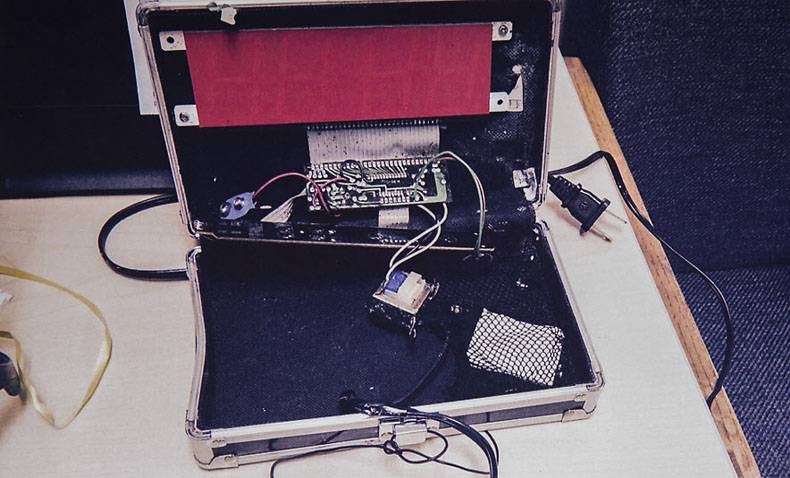
Ahmed’s clock

Suitcase bomb
This has several elements of media manipulation. The innocent child, the “racist” authorities overreacting out of irrational “phobia” in, of all places, Texas (!), the immigrant angle, the police involvement. What you wouldn’t know if you were just following this thing on Twitter or blogs (as so many do) is that the kid wasn’t accused of carrying a bomb to school, but of playing a hoax, by carrying the understandably suspicious looking contraption above to school. Call me a jerk, but I want to know if this kid’s parents are involved with CAIR.
Update: I posted this before I saw this:
His father, Mohamed ElHassan Mohamed, is a fascinating figure in his own right. He’s a Sudanese immigrant who has twice declared himself a presidential candidate in Sudan. When Florida pastor Terry Jones put the Quran on trial and later burned it in 2012, Mohamed was the Muslim holy book’s defense attorney…
Curiouser and curiouser. Or, rather, less and less curious.
The Shame of the Tame
I’ve been meaning to post here once per day at least, but with the time I had today I found myself meandering the web, posting to Twitter and other meaningless diversions with which I seem to be so smitten; so I’m getting cheesy and expanding on a comment I left at Sailer’s here. (The internal struggle against my inborn laziness–the Dale curse–is eternal. Oh what I could have done with my life if I was only more energetic, ambitious, intelligent, good-looking, brave, tough, strong, personable and a few other small things. This close, man!)
Anyway. Sailer:
What’s going on in Europe is a Flash Mob. In the Age of the Smartphone, a huge crowd can be assembled at much lower information transmission cost than just a decade ago. Chancellor Merkel assumed she could still break the EU rules to make a modest humanitarian gesture and get lots of thumbs up from the global media without setting off The Camp of Saints.
But that’s not how things work these days.
Here’s poor Ms. Merkel’s vision of a Flash Mob:
But here’s a different, more relevant kind of Flash Mob:
Me:
I’ve seen this juxtaposing of white and black flash mobs on YouTube before. The “white v black flash mobs” video below I find downright heartbreaking: a remarkable and beautiful performance of the “Ode to Joy” played on the street in a Spanish city, following a montage of the usual black mayhem over a fitting hip hop track of a gangsta un-apologetically and savagely proclaiming himself a “nigger”, proud of the worst stereotypes that is said to entail. That decent blacks cannot, will not, at least any longer, denounce much less do anything about gangsta culture, I find almost as outrageous as the behavior itself. It’s as if it’s all they have, in the end, and they know it; it’s commodified in music and culture, and converted to power in politics through the demagogy of “white privilege”. Why would they, after all, want to go back to the Bad Old Days where black inferiority was assumed? Because of the bloodshed on the streets? Because of the degradation of their women, and ours? Because black dysfunction threatens to consume us? Because of the decadence infecting us all? Ha! Small price, apparently, to pay for the status quo they, and their white enablers, so jealously protect. Arguing for a white version of order and society is now a sucker’s game.
Black culture is winning, hands down. It’s only if and when the protective embrace of a still, somehow, functioning Western system finally gives way that the whole game is up. Witness the behavior of Europeans in the face of the “refugee crisis” to see that there is an assumption that it will never give way, no matter how much strain we put on it. They’re probably right: it isn’t that something has to give, necessarily; maybe it’s just degradation and adaptation until we no longer recognize what we had, and no one will miss it.
Honesty is not possible–no people will accept they’re “inferior”–so reconciliation is not possible. But then, “superior” and “inferior” are social constructs–if you don’t care for enlightenment, “progress”, Western notions of order. Indeed; the whole idea that blacks are shortchanged by living in the West is utterly dependent on discounting the value of these things. What we’re really experiencing is the competition between competing models of society, one black, one white.
I don’t expect people to hate blacks because of this behavior–myself I’ve gone beyond fear and loathing to a blank, dumbfounded state; it simply Does Not Compute–but why, how, can we still hate ourselves, after such knowledge? How is it so many whites can be exposed to this disparity yet still profess things to be their opposite? The only verdict I can arrive at is more shameful than the convention that says white racism holds back black achievement: we are a weak people, over-awed and surrendering to the superiority–yes, that word!–of a stronger, more vigorous folk. We only try to copy, or appease. But then I’m wrong; there are people that willingly accept their “inferiority”: white people. Individual whites demonstrate their personal moral superiority by proclaiming their group moral inferiority. Whites are the best of people; whites are the worst of people. Whites are a fucked up people.
Having seen this flash mob comparison (or a similar) video before I found myself fantasizing grimly about one of these white flash mobs getting crashed by one of the black versions. Say, one of these food-court choirs proceeding along and all of a sudden here comes stomping through the middle one of those gleefully violent wilding packs. A less gruesome Cleon Peterson work come to life. This came to mind when I saw a European crowd serenading a group of “refugees”, some of whom appeared dumbfounded (what must they think?). It makes you want to cry. Shame on us.
Here’s the video I mentioned above:
And Cleon Peterson’s grim satirical vision of “oppressed”,
Orc-like humanoids taking their revenge on decadent whites:
Orc-like humanoids taking their revenge on decadent whites:
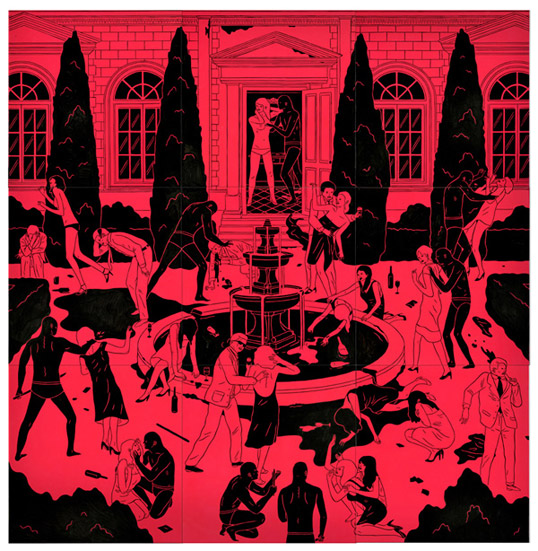
The Struggle
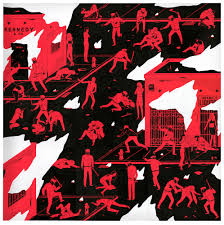
There is a War
Just let me die on the streets fighting this thing, whatever it is; let me reconcile and redeem this squandered life in an honorable death. Alas, even that much, too little, too late, I will not manage, I know. Cheerio!
Justice isn’t Funny and Funny isn’t Just
Steven Colbert’s Late Show is only two shaky episodes old, but the Social Justice™ scribes are, unwisely, not waiting for it to take off before trying to clip its wings. After regurgitating an old complaint about him employing an “all white” writing staff of seventeen men and two women (actually up from one, which is of course a hundred-percent increase! someone alert Nate Silver!), this Atlantic writer is already worried for the condition of the program’s soul:
But then. A writing staff is, in many ways, the soul of a show. The 19 people Colbert selected for The Late Show will decide much about how his influential platform will do its influencing. And Colbert himself, furthermore, is someone who—based on interviews he’s given as himself rather than the characters he has played on The Colbert Report and, now, The Late Show—seems to think deeply about the structures and systems that make the world what it is. He seems to understand, in a way many comedians don’t, that even the most innocuous kinds of “entertainment” play a role in defining culture.
And Colbert himself, furthermore, is someone who—based on interviews he’s given as himself rather than the characters he has played seems to think deeply [read: correctly] about the structures and systems that make the world what it is. He seems to understand, in a way many comedians don’t, that even the most innocuous kinds of “entertainment” play a role in defining culture.
What progressives don’t seem to understand is that these white, overwhelmingly male (and Jewish, but who’s counting?) writers are doing advocacy on behalf of “women and minorities” that they, and their humorless advocates in “serious” journalism are incapable of doing for themselves. If these shows were to yield completely, and make their comedy staffs resemble Bennetton ads, they wouldn’t survive to then to take their (dubious) role “defining culture” for the rest of us rubes. Unless of course they adopt the corporate model many of us who work for a living know: have the white guys do the heavy lifting and place the diversity hires in harmless, window-dressing positions. This is hard to do when your job is to sit in a room and compete to see who has the best ideas. Indeed, putting a token-hire discrimination-lawsuit-in-waiting in that humbling environment has the potential to be much more than the standard cost of doing business it is for corporate America. Colbert knows, even if he won’t allow himself to learn from it, that his writing staff, like Tom Wolfe’s protagonist in Bonfire of the Vanities says of the similarly non-diverse bond room at the fictional Pierce & Pierce, is “no place for empty gestures.”
This is leaving aside the ethical and artistic sin for which Colbert is so often praised: using art and entertainment (inexplicably placed in quotes above–what is she saying with that?) as a means of promoting political and social goals, rather than as a means of understanding politics and society. Art as factional propaganda rather than critical revelation. If Colbert is guilty of anything, it is this.
But being a successful promoter of the Narrative, fittingly enough, comes with the privilege of pointing out the silliness of the Narrative, as Colbert demonstrated when accepting an Emmy for his Comedy Central show (with, I imagine, mostly the same staff he’s taken to late night), by thanking a writing staff composed of “those guys, and one woman” and saying “I’m sorry for that, for some reason.”
Still, when these favored few show rare glimpses of awareness, it never seems to make it into their work in any meaningful way. A comedy show is too valuable for the symbolic gesture of token-hiring, but it’s also, in this case, too valuable to point out the absurdity of token hiring.
But what strikes me about this latest teapot tempest is its premature nature. The SJW modus operandi (whether Justice’s zealous auxiliaries recognize it or not) is to wait until a thing succeeds, then to sweep in and demand it be more “representative” (and to make the absurd argument that it needs to do this to succeed). This holds true across the professional and cultural spectrum, for various manufactured crises, from success in STEM fields to the military to comedy. The less representative a field is, the more potential it holds for plunder by diversity. These are tremendous growth opportunities, vast, untilled fields, for a political movement that has become a parasitic industry.
Perhaps they see the same pattern the rest of us are seeing, the other side of the counterfeit “inclusion” coin: it’s not that white guys are hogging up all the jobs and influence, it’s that non-whites and women are not contributing their fair share–and the white guys are either too busy doing to notice or too polite to mention it.
Some people have arguments, some have wit, some have both; for the rest there’s photoshop on Twitter.
Western Values are Production Values
Steve Sailer has pointed out this same young (or “military age”) fellow toting about a picture of Angela Merkel like some sort of Byzantine icon of Jesus (Ms Merkel achieves secular sainthood) has now managed to appear not once, not twice, but three times in news reports about the ongoing refugee invasion of Europe:

“That’s good, Dahood, but less the cheerful shopper, more the grateful pilgrim, like we discussed…”

“Okay, okay, but the light is all wrong…”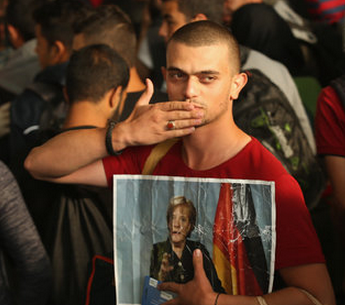
“Yes! The gesture is genius! That’s why you’re a star! Wrap and set up the next shot.”
We’ve seen this sort of thing before, in another case of the political and media elites coming together to sell the public on a desired policy, as commenter JohnnyWalker123 points out in the Sailer comment thread:
I remember back when the Serbians were supposedly ethnically cleansing the Kosovars in 1999, the television channels and papers kept showing up the same image of a refugee woman over and over again. It was bizarre how often she kept appearing. So much so that someone mentioned it on one of the major cable networks.
The eliciting of emotion to manufacture consent in this way was parodied brilliantly back in 1997 in Barry Levinson’s film about a political operative teaming with a Hollywood producer to create a fake war with Albania to distract from a scandal involving the president and an underage girl, Wag the Dog:
In the film Woody Harrelson’s Private Schumann is actually a dangerous convict from a military prison:
Likewise, any misfits who get through will be fine as long as we keep them on their meds (weed, alcohol and pussy, if my observation of Portland’s own military age Muslims is any good) and don’t provoke them.
All this production is missing now are the product placements.

“Kirsten, we’ll add the racist mob later of course, just give us some sort of reaction to that and hold the chips a little higher…”
More Human Than Human
Hillary’s potential running mate will make her look even more human!
…imagine a Chu stamping on a human face, forever…
“The enemy at last in view, huge and hateful, all disguise cast off…”
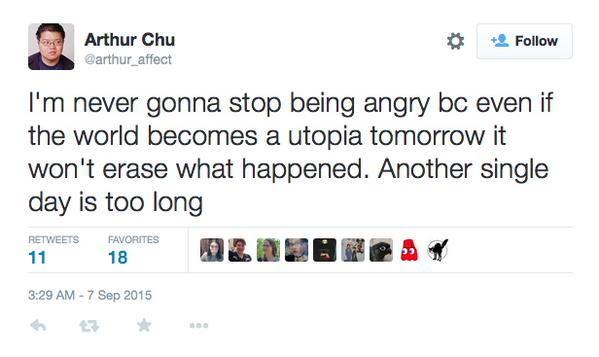
It’s forbidden to speak of it in such terms, but the (hopefully) premature triumphalism of non-whites regarding the (hopefully not) inevitable demographic damnation of white America bears all the marks of betrayal.
Not even the most fervently liberal white (excluding the Alinsky-ite radicals, who really gave us fair warning) of fifty years ago would have thought, much less said, that the success of the unprecedented opening up of American society and politics to minority groups did not entail–indeed, depend on–a concomitant effort on the part of those groups to live up to their end of the bargain–to not destroy this wonderful system we had built. We’ve let them into our house and now they’re setting it on fire.
Desperate Measures
To explain the odd, old posts below, I’m editing and republishing old stuff in a desperate attempt to unblock myself. I’ve been trying to get back in the groove for months, only able to occasionally blurt out something, writhing inwardly as the world churns on in fascinating horror. Maybe I’m just overwhelmed. It’s probably that I don’t really have that much to say, and I don’t like repeating myself. Anyway, there’s the explanation that wasn’t requested by a reader who isn’t there.
 untethered