
The lineup for something called the JoCo Cruise does not inspire.
Torah Tomorrow
I’ll face the Jew again tomorrow for Torah Talk with Luke Ford via Google Hangouts, where you can log in and ask questions. 9:00 AM Pacific.
Harry Dean Stanton, 1926 to 2017
Harry Dean Stanton in 1978’s Straight Time with Dustin Hoffman (spoiler):
Built like a brick temple
It’s taking them longer than planned to demolish the United Workmen Temple in downtown Portland, also known as the Tourney Building, built in 1895.

They had to bring in a bigger crane to take down the elevator shaft I believe. I think I saw it arrive this afternoon. They’ve been picking away at her innards in the meantime.



The building behind it is the Mark O. Hatfield Courthouse, 1992. I know nothing of architecture, but to me this suggests brutalist style tempered by the slightest postmodern whimsy:


I have no idea what the conning tower like thing is supposed to represent. It’s a little unsettling at this historical point that progressive Portland has a Stalin-esque courthouse.
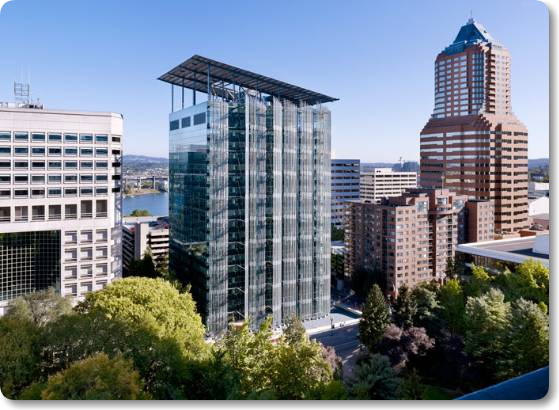
The federal building is even less reassuring. It evokes secrecy and opacity, facing off against City Hall directly across from it, it’s literally shrouded from view by a confusing array of what look like wrought-iron shutters:

Torah, Torah, Torah
Luke opens with a funny news item about a rabbi turned real estate hustler that is totally lost on my goyishe kopf.
At 4:20 I reveal my ethnicity to the Jew.
Luke sets himself up for a Holocaust joke at 4:40
Goy v goy at 5:50
At 9:20 I am propositioned by the Jew.
At 16:30 we talk about art.
At 21:50 I report on recent Orc sightings.
24:40: I tell a tale of a Lyft ride from hell and a social justice three-way that cannot be unheard.
At 28:05 Luke wonders if the coming Diversitopia will be Good for the Jews.
At 33:30 I congratulate a woman on her “beautiful white baby”.
44:00: “What kind of Becky are you?”
46:20: The Pet Rock of Social Justice and other great ideas.
1:05:05: Pretty girl blows me off.
1:24:15: The Torah is anti-Diversity
Shabbos Goy, of a sort
I’ll join Luke Ford again this Sunday for his weekly Torah Talk, at 9:00 AM Pacific Time, live-streamed here, on Twitter and at Luke’s.
Tangled up in Who
We’re long conditioned to social and political questions being decided by identity, not action. It isn’t who did what but who’s who. That conditioning is considerable. Witness the divide between true-believing media elites and the public over the “appropriateness” of President Trump’s remarks on Charlottesville. Media types seemed genuinely oblivious to the clear narrative emerging from their cacophony: on one side you had Nazis (ffs!), on the other, not; it doesn’t matter who did what!
We still use the language of objective universal rights, but, politically and culturally, the question of who’s right (and who has rights) is a Sailerian who, whom calculation increasingly complicated by the growing number and diversity of America’s grasping aggrieved.
Critical theory’s “intersectionality” is an attempt to manage these inevitable conflicts and stresses like a system of traffic lights, while harnessing its energy–anger–like a power utility. It appears inherently unstable.
Good people are grappling with the problems of intersectionality. That’s why you have to so often read between the lines in news reports and analyses, sometimes to find a thing represented as its opposite.
If the only two words you read in a news report was”Islamophobic backlash”, for instance, you’d confidently guess that article to be about an attack by Muslims on others.
That’s why you have to suss out with some effort what the subject of this Washington Post article really is:
When Kate Ross first came out, she would go to lesbian bars and parties by herself. She didn’t exactly get a warm welcome. At the lesbian dance party She Rex, which used to pop up at Chief Ike’s Mambo Room, she says a fellow partygoer took one look at her high heels and long hair and called her a “confused straight girl.”
“I shaved off all my hair and had a mohawk,” she says. “No one questioned me after that.”
Well, looks like we got us quite a story about discrimination, intimidation, conformity even, within the underground lesbian dance scene (is there a more depressing phrase?). Great! Not so fast.
Moments such as those led the 33-year-old, who works in small-business management, to help found the Coven, a safe space that has expanded to include a monthly dance party, a book club, theater trips and panel discussions over the past few years. Though the concept has gotten backlash on college campuses for potentially threatening free speech, safe spaces have become increasingly important at bars and nightclubs, activists say, particularly in the aftermath of last year’s attack at the LGBT nightclub Pulse in Orlando.
I suspect what used to be called a “lipstick lesbian”–straight-looking–is increasingly unwelcome in the lesbian club scene (perhaps as it hardens around a more militant identity in the post-Obama era) and this Ross woman created an alternative “safe space” free of violence and intimidation where one isn’t expected to look (or act) like Robert DeNiro in Taxi Driver to be safe.
Mentioning the college safe space phenomenon and the Pulse massacre (with the automatically implied inference it constitutes the threat of “homophobia”, not Islamic terrorism) are deliberate obfuscations of the reality that the butches are intimidating the bourgeois.
But what constitutes a safe space isn’t the same for everyone, and organizers such as Ross — who seek to welcome all, regardless of sexual orientation, ethnicity or gender identification — are facing resistance, including from the very community they’re trying to welcome. Critics have accused Ross’s parties of not being “really queer,” raising the question of whether safe spaces must be exclusive to be truly “safe.” For some, it’s a requirement; for others, a space can’t be safe if it isn’t exclusive to the audience it represents.
For everyone, it seems to be a conversation in progress. [bold added]
If by “conversation” a progressive means sit still while I dictate my terms, then “conversation in progress” has to mean those terms are fluid and subject to whim.
Reporting these internecine squabbles is trouble for the Narrative. Freedom of association is anathema to it, yet the divisions it produces as a necessity produce ever more fissioning of groups into hostile camps.
The same heated demagogy dividing whites from blacks, straights from gays, men from women, and on, can only have some collateral negative effect on relations between these favored identity groups, straining already alliances that are far more conceptual than real (such as between blacks and gays).
Goy and Yid, God forbid…
Alt Right Torah Talk is live with Dennis Dale, working class hero! The goy perspective vs the Jew perspective: https://t.co/YdlvjMqogY
— (((Luke Ford))) (@lukeford) September 3, 2017
I joined Luke Ford for his weekly Torah Talk broadcast. We discussed this week’s Torah reading, Deuteronomy 26-29:8, and how it relates to the present.
“Get out there, enjoy the view…”
 untethered