Around half past one this morning I came upon a crime scene at the south end of downtown, just outside of Portland State University.
“Is that what I think it is?” I asked a guy standing away from the tape talking to a little Mexican cop.
“Yeah.” He smiled sardonically. “Don’t you love Portland?”
The police tape howled in a low sinister drone, holding up somehow in the gale-like wind that had set in late Sunday night. The body was under what looked like a yellow tarp.
A big, impressive looking cop with a shaved head was brought over to the tape to hear a woman’s story of what she saw. His manner was casual. I asked a young man standing nearby if he saw what happened.
“Yeah.” He said. “I heard shots from my window and I came over to look and,” with the slightest nervous tremor in his voice “a guy was standing over the guy on the ground, and he shot him, bam, bam, bam, and took off.”
“Jesus.”
“Then he, or somebody, came back and he was checking him, like you know, to see if he was okay maybe?” he held his wrist; he was trying to say “check his pulse”, but couldn’t come up with the words at the moment. “Or he was just, I don’t know, going through his pockets.”
I took a snippet of video before a relatively cheerful female cop told me to shut it down.
PORTLAND, Ore. (KOIN) — A woman was found dead after a shooting in downtown Portland early Monday morning, officials said.
According to Portland police, officers responded to a report of a shooting around 1 p.m. at SW College Street and SW 6th Avenue. Officers reportedly found the woman deceased…
Portland State University released a statement about the shooting later in the day, saying the school community is “saddened to learn that the epidemic of deadly gun violence that has plagued so many cities has hit close to home.”
“PSU prioritizes the safety and well-being of our students and employees and our Campus Public Safety Officers are in contact with the Portland Police Bureau which is leading the investigation,” the statement read. “We don’t have further information about the incident at this time and there is no ongoing threat to our campus.”
The civil rights movement has been dubbed “the second Reconstruction”, atoning for the first, the failure of which convention attributes entirely to southern white racism. And while the civil rights movement is deemed by that same convention as an unqualified success (that is nonetheless never-ending and always incomplete), the insane histrionics that go as civil rights now are due at least in half to the wild expectations those histrionics cultivate in black Americans. Those expectations are that they should live as royalty.
As a racist, I see those expectations as originating ultimately in the black American character, not in the propaganda that flatters it. Even modern full-spectrum propaganda has to choose its seed for the given soil.
As the civil rights movement/second reconstruction failed to close racial disparities and release all that dammed-up black genius (one of the movement’s early promises was to bring online all that “underutilized” talent) its narrative adapted to keep the movement–now an industry and state religion–going. The racial looting of “equity” displaces the meritocracy of “equality” and the least appreciated racial disparity is between how whites lean (equality; fairness) and how blacks lean (equity; gibs).
For blacks, equality-as-equity is not just equal distribution but the settling of historical scores. It’s been said the average slave in the south thought that liberation meant he would henceforth live a life of leisure, like his erstwhile masters; this is understandable as his world didn’t go beyond the plantation. Black people, fed a steady diet of demagogy from the cradle, and like most people, view equality in the way of the poor woman in the story about the French Revolution: I suppose we’ll all be equal now, a lady asks her; yes, she replies, from now on I’ll wear finery and you’ll go about in rags. Critical race theory holds American whites lived as a sort of royalty on the backs of blacks, until the civil rights movement–the Second Reconstruction–set things right–not equal, but right.
But there’s more: black people are naturally more dominant, more prone to megalomania and sociopathy, and more reverential of brute power. Black society reflects that, in, among other things, raising up thousands of little tyrants, especially in entertainment. Black entertainers now are to black Americans as British royalty is to Britons–except with a far higher level of genuine admiration.
The unique circumstance of black overrepresentation in culture, in sports and entertainment where black charisma has–disastrously I say–seduced the nation, contributes to black feelings of superiority. This, combined with the gaslighting convention that black mediocrity everywhere else is a result of white malice, gives, understandably, blacks (and duller whites) the impression that blacks are a sort of master race–equal at least where they are not obviously superior. A chosen people–chosen by the Chosen, but that’s a longer story.
It’s almost inconceivable to the conventional thinker (what with all the propaganda) that not only might blacks be less predisposed toward liberalism and democracy, they might be predisposed toward their opposites–that is blacks might be predisposed to the way they are.
Black America now is not the product of oppression but of indulgence. This indulgence is taken by blacks as more confirmation of their royal status. In modern black lore every black woman is a queen and every black descended from royalty. Nearly every hip hop artist is a self-styled tyrant king–America is littered with aspiring Big Men in the African style.
Black people keep telling us but we refuse to listen: they are kings, not democrats.
Volunteer brigades of acolytes on social media combine with the mainstream press to defend black public figures from a sort of lèse-majesté that is invoked whenever we are prompted to outrage because so-and-so dared criticize black so-and-so(!). Those forces rallied to defend Will Smith for slapping Chris Rock on stage at the Oscars–a ceremony I and the few people I talked about it with did not know had occurred until Will’s slap hit the news.
The ceremony had been handed over to a black producer, in keeping with the current “racial reckoning”. The show was to be a celebration of black royalty. Will Smith was escorted to his place of privilege near the stage (conveniently enough) with his wife Jada looking like a Chinese dowager empress, sitting erect and imperious in a gown with a massive train, communicating with her icy glare we are not amused by the tepid joke of court jester Chris Rock. Smith was put on the spot, as a black American royal with black America’s expectations beaming through the dead-eyed glare of the Bond villain looking creature he would have to take home later.
It’s not just irony that the young Smith went as the “Fresh Prince”; the title was a good-natured sendup, when such was still possible, of the same black regal culture that produces murder and exploitation. Smith has made the journey along with the movement; he’s real royalty now and royalty is a sort of confinement of expectations and limits. The Fresh Prince is dead, long live the new Prince. (Let us not forget the juvenile aesthetic of Prince, and his royal purple.)
Who can blame blacks for thinking they are a class of royalty? Who can blame them for thinking it’s their country? From the composition of advertisements on television and the internet now one would get the impression America was peopled mostly by blacks–and this is not new, foreigners have long vastly overestimated the black American population because of overrepresentation on television. I saw a banner ad for sun-block online recently–of course the model was black. And the cliche is true: these television blacks are amazing: intelligent, kind, generous, oh-so-patient with the hapless whites they encounter.
Now it’s funny, and you should laugh; but it’s also a sin, and you should wish those behind it a humiliation equal to ours. And I’m not talking about black people.
Smith was handed the Oscar for his lead role in, wouldn’t you know it, “King Richard”. The standing ovation sanctioned his actions.
I have no idea if his acting was any good. But an amateur performance is worth noting here. Just as the Oscars were handed over to black America (and comically fell apart) a seat on the Supreme Court is being handed over to a black woman in recognition of her noble birth. Cory Booker’s paean is something to behold, as he deplores the “shocking” treatment of being questioned, like a mere commoner.
This February, Bruce Harrell, newly installed as mayor of Seattle, made it official that his city has gone into decline. “The truth is the status quo is unacceptable,” he said in his first state of the city address. “It seems like every day I hear stories of longtime small businesses closing their doors for good or leaving our city.” But it’s not just small businesses. In mid-March, Amazon announced that it was abandoning a 312,000-square-foot office space in downtown, citing concerns over crime.
That such woes should afflict one of the richest cities in the country, with a median household income of over $100,000, cannot be blamed on economic decline. Yet much of Seattle’s core looks like a pockmarked ghost town. Businesses on both sides of Third Avenue, a major thoroughfare, are boarded up. Blocks from the Four Seasons hotel and the Fairmont Hotel, tents crowd the sidewalks, and drug users sit under awnings holding pieces of foil over lighter flames. Traffic enforcement is minimal to nonexistent. The year 2020 saw a 68% spike in homicides, the highest number in 26 years, and the year 2021 saw a 40% surge in 911 calls for shots fired and a 100% surge in drive-by shootings. Petty crime plagues every neighbourhood of the city, and downtown businesses have paid hundreds of thousands of dollars to fund their own security.
What happened to Seattle? The answer, of course, depends on your politics. In the news section of the Seattle Times, for instance, a reader is unlikely to see any consideration of a link between policing and public safety. “No single cause for 2021’s surge in gunfire in Seattle,” declared a typical recent headline over an article that points only to possibilities such as the pandemic or an unlucky cycle of “retaliatory violence”. But the majority view in Seattle appears to have shifted toward an acknowledgement that the unrest and destruction that occurred after the killing of George Floyd in 2020 marked a turning point and that the city’s policies toward its police force, whose ranks are now depleted, are relevant to understanding the story…
Portland and Seattle have taken similar, probably coordinated, arcs through the post-2020 “racial reckoning”, with riots kicking off in unison on May 29. In both cities it was taken as a given by politicians and media that George Floyd’s murder proved, literally overnight, the irredeemable racism and corruption of our police forces. Not a single voice in public life dared point out the absurdity of a case of alleged police brutality in Minneapolis (of all places) indicting Portland or Seattle police.
But politicians and the activist community (with includes antifa) made this determination; the people were barely consulted. To the extent they were, in elections that year Portland rejected Sarah Iannarone, antifa candidate for mayor (but narrowly), and threw out the doltish uber-progressive commissioner Chloe Eudaly. But the only recourse available to them was the gormless Ted Wheeler and center-left (for Portland) commissioner Mingus Mapps. Portland’s much smaller city government–four commissioners and a weak mayor–may have made it easier for Portlanders to tap the brakes on police abolition.
After a violent first week of rioting Seattle’s Mayor Durkan moved to limit police tactics.
When the protests grew violent, police officers began to use various non-lethal weapons to control the crowd, including pepper spray and tear gas. This led to complaints, lawsuits, and stinging condemnation in the local press. On 5 June, Seattle’s mayor, Jenny Durkan, declared that officers “do not need to be using tear gas at protests as a crowd management tool” and banned the use of it for 30 days. Many officers felt they were being asked to maintain order in violent crowds while surrendering all of their crowd-control tools. “People were throwing bottles and rocks, and we had to split this thing up. God forbid after multiple, multiple, multiple warnings that we’re gonna throw gas, guys, you better disperse, we throw gas,” says J.D. Smith. “So then what? Oh, Seattle PD, look how heavy-handed they are.”
On June 6 Ted Wheeler did the same along with mayors in virtually every city with both leftist control and rioting.
Officials in Pittsburgh, New Orleans and Washington, D.C., have proposed bans or limits on the use of tear gas, and Minneapolis, where Floyd was killed, has halted the use of choke holds and neck restraints like the one that killed him. California Gov. Gavin Newsom ordered police there to stop training officers in choke holds, and Bellevue, Washington, Police Chief Steve Mylett on Friday banned his officers from using controversial neck restraints except when deadly force is needed.
In Denver, U.S. District Judge R. Brooke Jackson on Friday imposed restrictions on the use of chemical and less-lethal weapons by police, saying officers there had failed to police themselves when it came to using them. His order, as he modified it on Saturday, requires the use of such weapons to be approved by a supervisor with the rank of lieutenant or higher – and only in response to violence or property destruction personally witnessed by the supervisor.
Seattle came into the crosshairs of Barack Obama and Eric Holder’s Department of Justice in 2011, which declared “a number of highly publicized incidents” warranted a pattern and practice investigation, which of course yielded a federal consent decree, the lifting of which was imminent as summer approached.
Prior to the summer of 2020 the department had been receiving encouraging communications from the mayor’s office, and city officials were planning to ask the federal government to lift a consent decree that had been imposed on the Seattle police in 2012. In 2016, Barack Obama had even invited the department’s then-chief, Kathleen O’Toole, to the State of the Union, and a federal judge had ruled in 2018 that the city was in “full and effective compliance” with the decree.
Then Derek Chauvin took his fatal knee, and the police department fell out of compliance–as determined by the Mayor--because of its rough handling of the rioters who took over a police precinct and six city blocks for weeks.
Mayor Jenny Durkan announced on 3 June that the city would no longer seek to lift the consent decree. Seattle city council member Teresa Mosqueda vowed to lead an “inquest” into the budget of the Seattle police and said she wanted to cut funding by half, a view echoed by fellow council members Tammy Morales and Kshama Sawant. City Council president Lorena Gonzáles blamed the police response to the protests for turning “our densest neighbourhoods” into a “complete war zone”.
Portland ran afoul of Obama’s racial inquisition around the same time, when Senator Ron Wyden and Congressman Earl Blumenaur lead Oregon politicians in asking the Department of Justice to investigate the Portland Police Bureau after a fatal shooting in 2012. A consent decree was issued in 2014 as a foregone conclusion and politically pliant former chief, now Multnomah County sheriff, Mike Reese was instituting the recommended reforms before he got the letter. The city was long in compliance and the order was due to be lifted in January 2021–then the reckoning came and with it Biden’s election. Not so fast, federal prosecutors said:
On Wednesday, city officials learned that the combination of massive protests, COVID-19 restrictions, and budget cuts effectively pushed the city out of compliance with the DOJ’s legal agreement. In a 73-page report explaining the decision, the DOJ writes that, despite 2020’s unforeseen pressures, Portland and its police are not excused from upholding its obligations in the 2014 agreement.
The DOJ points to four areas in which the city has missed its mark: First, police repeatedly violated PPB’s use of force policy by using disproportionate force against protesters; second, more than half of PPB’s officers skipped mandatory training; third, the city’s Independent Police Review (IPR) was unable to investigate complaints against officers in the required amount of time; and fourth, PPB failed to present its 2019 annual report to the public.
Here, as everywhere, the shock and awe of the riots created sudden powerful momentum for more than merely anti-police legislation, propelling any project invoking black civil rights, as scared or complicit politicians opened the floodgates to release the pressure. But where was this pressure coming from? Not the public.
The pressure–that above the surface–came from a couple of hundred antifa riding an unprecedented campaign of media propaganda with a level of mobilization, discipline and demagogy rivaling any of history’s great war propaganda campaigns. And the Kabuki is so lurid and intense, and we so already disjointed from reality, we feel as if we are engaged in the action, not passively observing; a giant movie production in real time invading every corner of life, never to be finished, searing and disappearing as it cuts through history.
The system has achieved this impressive feat of popular disenfranchisement it seems in large part by its insane level of control over who gets to exist in public life and thus who gets to run for office. With horror I scan the bleak horizon for a single impressive figure to give focus and principle to–to what we call “Trumpism” because we’ve gone so off track the concept of national interest and pride is alien now. There is no one, and I have to wonder if they are out there beyond the horizon at all–or if the years have so worn us down that such leaders aren’t even possible; or, if the people to receive him are any longer possible. Are “we” still possible?
PORTLAND, Ore. — A Portland man convicted of assaulting a federal officer is now facing charges in connection with his infant child’s death.
Court documents say 22-year-old Dakota Means is charged with two counts of second-degree murder.
According to a memorandum opposing bail filed by prosecutors, the child was admitted to Randall Children’s Hospital with a serious brain injury in April of 2021.
The child later died from his injuries in June, and the medical examiner found the cause of death was blunt force trauma.
Court documents say a doctor also found the child had been previously abused with evidence of rib fractures.
Prosecutors allege Dakota was the only one in the room with his child when the injuries occurred. They say the child’s mother had also told him he needed to be more gentle with the children.
Means was originally charged with assault and child mistreatment before being charged with second-degree murder. He pled not guilty to the charges in 2021.
The sullen, dead-eyed and moon-faced mulatto became familiar to me in summer of 2020 as one of the many would-be thugs attracted to the action and easy prey at downtown’s continual occupation by white BLM protesters. When I read of his arrest for assault on a federal courthouse employee in August of that year, I recognized this face that only a slatternly single white mom from Gresham could love.
Turns out I’d seen him in video of events leading up to the savage beating of a man downtown on August 16, when a crew acting as BLM security put him in a coma for trying to help a transvestite they were roughing up–a likely associate of these men later shot and killed a Proud Boy for walking downtown.
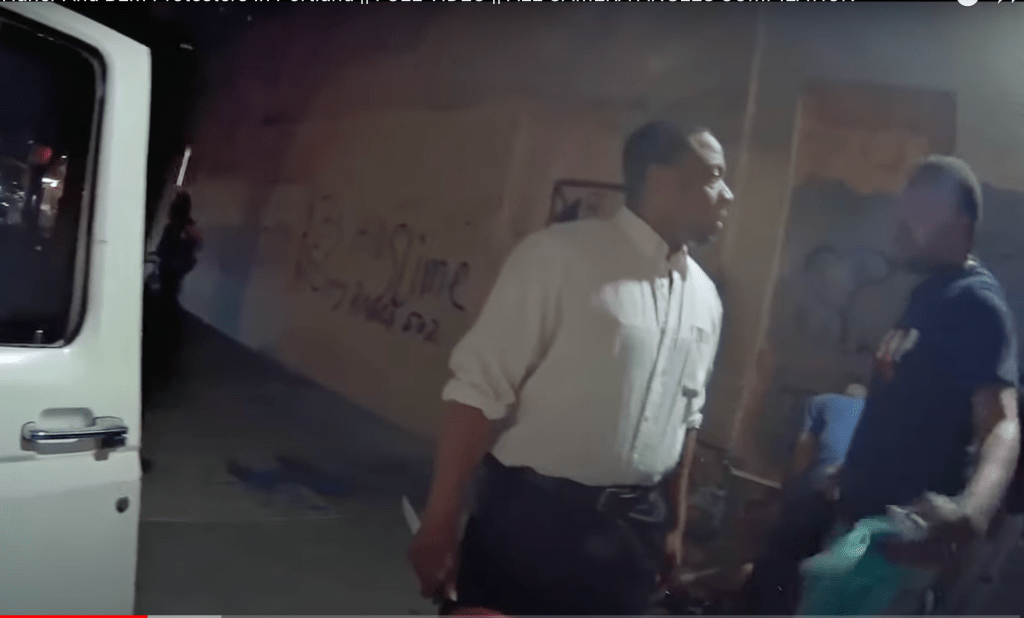
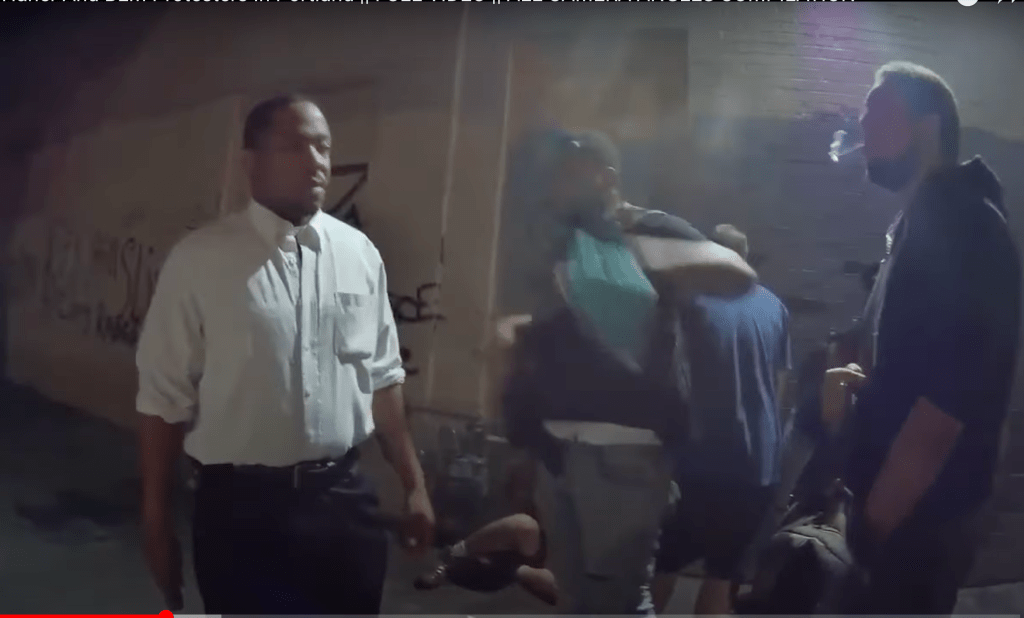
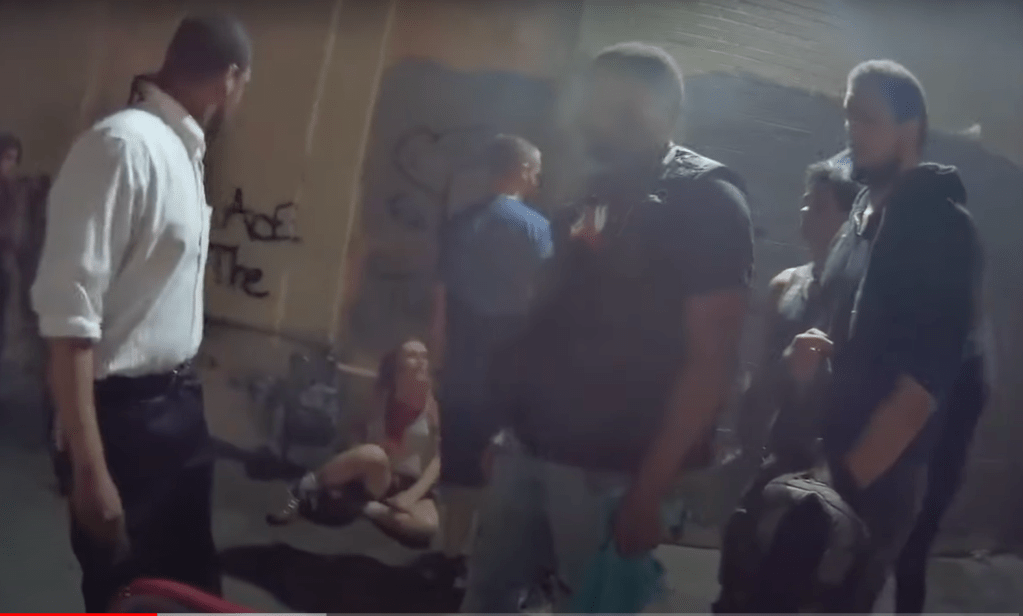
YouTube won’t allow me to share the age-restricted video someone put together here, but at about 2:40 you see Dakota threatening a man with a gun, or bluffing that he has one in his backpack. The man’s holding a knife because Dakota’s crew has him surrounded, after he pulled over to help the transvestite, who’d caught their attention when they were knocking about a white guy they had just marched out of the protest a block away, for looking suspicious. At one point, inexplicably, Dakota threatened the transvestite by promising to get his gun; comically, every time I’ve encountered this guy, including once in person, he’s threatening to bring out that gun.
I’ve included screenshots of the video: the brother with balls of steel playing the righteous Denzel Washington role is cradling a knife in his right hand guarding the transvestite on the ground in the background. The man in the middle is demanding the man with the knife stay out of it by yammering “fuck these white people nigga” repeatedly, while resourcefully wrapping his left hand with a towel for knife defense and squaring off; the hero holds his ground. Dakota, who doesn’t appear to be involved in the beating later, is making a show of hiding his left hand in his backpack and telling the man to put down the knife, answering “you’ll find out soon enough” when asked what’s in the bag.
The white guy in a blue tee in the background is Adam Haner, who is beaten into a coma by the crew at the end of the video. Very tough to watch.
Things were at their worst in August of 2020. The action here takes place just a block over from the besieged police station; lawlessness reigned. I was passing this same intersection an hour and a half before when I recorded a group of very young aspiring thugs beating down a very young black bloc kid–over, it appeared, their beating up a homeless man. They’re part of a group of kid-thugs that appeared on the streets at this stage, harassing the weak and fighting amongst themselves.
For a while it was taken for granted the police would not show up when called downtown until someone had to be picked up off the asphalt–and that not without difficulty. The police did not own the streets.
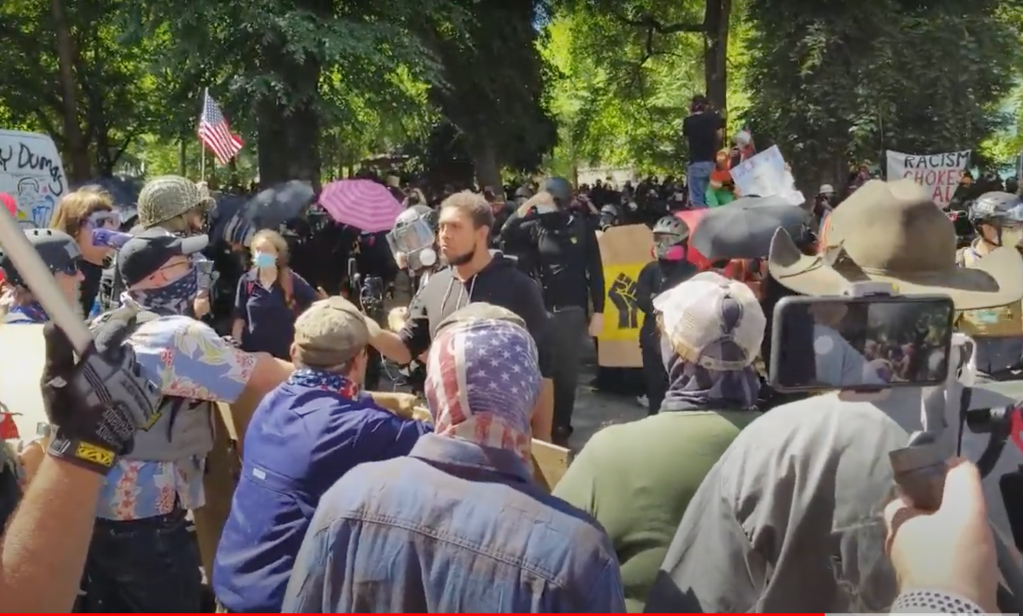
Less than a week after this I recorded Dakota at the August 22 Patriot Prayer rally that antifa eventually chased out of town, threatening to return with his “Glock” before storming off dramatically; again, every time I’ve encountered him, in the news–his “assault” on the fed employee reads more like threatening, with him promising to, yes, return with a gun–on video and in person, he’s invoked that threat. But the gun never appears–indeed, he seems to disappear when things go bad–and he managed to keep himself out of serious trouble and mostly out of jail in Portland’s forgiving law enforcement environment until now. Alas for that child. Dakota appears toward the end of this video.
For the conviction on the federal assault charges he got two months, time served, and was on probation when his child was beaten into a coma in April 2021, eventually becoming that bloody year’s youngest homicide victim.
[At his January 2021 sentencing for assault his] lawyer said that Means early this year was living with his wife and was expecting a second child in March. Means also was set to get a mental health assessment and treatment, the lawyer said then.
That second child was his son Hunter, who was six weeks old when he went into the hospital last April.
Tell to your cellie, Dakota, tell it to your cellie
Whistling past Hunter Biden’s laptop and taking a break from the Ukraine refrain the Washington Post today returned to its favorite subject, which is its least favorite people, white dissidents:
OLYMPIA, Wash. — Melanie Gabriel became the teen idol of Washington state’s anti-masking movement last fall when she showed up to school and, claiming a medical exemption, marched barefaced to class.
As Gabriel’s protest continued and she was barred from campus, she drew support from self-styled militia groups and other far-right extremists who saw the anti-mandate movement as a chance to rally conservatives toward more-militant stances. Members of the Proud Boys offered to escort Gabriel to class, prompting a security lockdown of three schools.
You might think locking down three schools because of suburbanites with picket signs is unnecessary–but it isn’t if your goal is to shock the normies with the illusion you’re under assault; the action is what the Left likes to call “performative”. Later it will be referred to as proof of the threat presented by the Proud Boys et al–and it has the immediate effect of gaslighting the children and parents. Kids were “sheltering in place” as if in an active shooter–or Cold War-era “duck and cover”–drill.
The aforementioned Gabriel is only 14 years old and the staid old merely liberal Post would have–disingenuously of course, but still–lamented her exploitation by political activists. Of course that might draw attention to the routine use of kids as props by the establishment, and a 14 year old girl campaigning for something like “trans rights” up to and including genital mutilation would no doubt be an inspiring tale of youthful activism. The new Washington Post is all for using children to advance causes, so all they can do is lament the local resistance has their own Greta Thunberg, less the unattractive, well, everything.
Now, with the lifting of most mask and vaccine requirements, Gabriel and her far-right backers are mobilizing the networks they’ve built over the past two years toward a new goal: November’s midterm elections.
Gabriel spoke this month at a gathering that was emblematic of the increasingly blurry lines on the right — it was organized by the far-right Washington Three Percent and sponsored by a conservative student group, Turning Point USA. With the state Capitol dome in the background, speaker after speaker told supporters not to get complacent with mandates gone.
“Just because they’re lifted doesn’t mean they’re going to stay that way, and that’s why we’re all here,” said Gabriel, a striking figure in a bright crimson bob, cat-eye makeup, and a T-shirt with the anti-Biden slogan, “Let’s Go Brandon.” Her bullhorn was decorated with stickers that read, “Say No To Critical Hate Theory” and “Allergic to socialism.”
A man in the audience yelled that Gabriel should run for governor.
“I will!” Gabriel replied. “I will run for governor. And I’ll run for president. And I’ll run for everything!” She waited a beat before adding: “Once I’m of legal age.”
That’s the kind of youthful energy far-right movements are working to harness across the country as they teach the pandemic’s newly minted activists how to get out the vote.
Organized political redress used to be seen as inherently good; now that normalcy itself has been put beyond the pale to make room for trans rights and whatever comes next (Globohomo needs psychological lebensraum, lots of it) unregulated political action is seen as inherently bad–routinely the Left now, with apparent lack of self-awareness, will sound alarm at basic, innocuous political organization on the Right–registering voters goes from sacred to sinister.
Extremist questions vaccination rules at town hall meeting, FBI alerted
Extremism trackers say the past two years of fighting pandemic restrictions have given far-right groups a new generation of recruits and a blueprint for taking the lead in conservative organizing. The midterm season, they warn, brings a heightened risk of political violence, as armed groups build on those gains to push deeper into the mainstream.
“In Olympia today, we saw paramilitary groups and a range of other anti-democracy activists aggressively working to recruit young people and making pledges of unity against what they see as their common enemies,” Eric K. Ward, executive director of Western States Center, a regional extremism watchdog, said in a statement after the event where Gabriel spoke.
Western States Center is a local non-profit whose donors include the Gates and Ford foundations, with a focus on “gender” and race that looks to be in the business of providing institutions with anti-racist “worksheets” and the like.
The Post seems to lament no antifa faction showed up to turn the event violent–which would then be blamed on the demonstrators.
Unlike at previous far-right gatherings in Olympia, no leftist counter protesters showed up, and the event was peaceful. Journalists were encouraged to refer to it as a “freedom festival,” not a rally. On the damp statehouse grounds, leather-clad bikers chatted about gas prices with khakis-wearing politicians. Gun rights activists told college students that Russia’s invasion of Ukraine is an example of why they consider the Second Amendment untouchable. A voter registration table sat next to a self-styled militia’s information booth, a reminder that, in this milieu, there are two paths to making change.
Not that anyone’s paying attention, but the peaceful nature of these “far right” rallies is only ever interrupted when black bloc shows up expressly to fight, something this paragraph inadvertently advertises. The author seems to lament no one showed up to ensure the “leather clad” can’t caucus with the “khaki wearing”–and that is the genuine concern here, the subtext of this article howling from the depths of elite progressive paranoia: “the people are conspiring together!” Something must be done.
Articles like this tend to hit all the narrative bullet points (with complete spontaneity, I’m sure), and this one does not neglect the latest, and one we can expect to see a lot more of–the threat of a “global far right”.
Neoliberalism’s contradictory nurturing of Ukranian nationalism as a proxy in its war against Putin’s Russian nationalism is, like most things when you own the Megaphone, a feature not a bug, and any expected reckoning with Azov if and when the Ukraine is wrested completely from Russia folds perfectly into the budding propaganda campaign casting domestic resistance as connected to a global right wing terror matrix being pushed hard by our aforementioned friends at Western States Center as well as far bigger and more influential entities.
In this video from something called the GW Program on Extremism a man named Cohen tells us all about the threat of the rising global right, based entirely it seems on the entirely predictable increase in dissident speech online responding to the Great Reset, the Racial Reckoning, Covid, Critical Race Theory and now war hysterics. They are telegraphing their pivot, away from a global war on “Islamic terrorism” to “right wing terrorism”. The ghouls, spooks rather of the intelligence community get to keep partying on the taxpayer dime and the final suppression of dissent is achieved. We won’t be able to say we weren’t warned.
From Pendennis, completed in 1850, by William Makepeace Thackeray:
“There sits the Chinese Ambassador with the Mandarins of his suite, Fou-choo-foo brought me over letters of introduction from the Governor-General of India, my most intimate friend, and I was for some time very kind to him, and he had his chopsticks laid for him at my table whenever he chose to come and dine. But he brought his own cook with him, and — would you believe it, Mrs. Bungay? — one day, when I was out, and the Ambassador was with Mrs. Archer in our garden eating gooseberries, of which the Chinese are passionately fond, the beast of a cook, seeing my wife’s dear little Blenheim spaniel (that we had from the Duke of Marlborough himself, whose ancestor’s life Mrs. Archer’s great-great-grandfather saved at the battle of Malplaquet), seized upon the poor little devil, cut his throat, and skinned him, and served him up stuffed with forced-meat in the second course.”
“Law!” said Mrs. Bungay.
“You may fancy my wife’s agony when she knew what had happened! The cook came screaming upstairs, and told us that she had found poor Fido’s skin in the area, just after we had all of us tasted of the dish! She never would speak to the Ambassador again — never; and, upon my word, he has never been to dine with us since. The Lord Mayor, who did me the honour to dine, liked the dish very much; and, eaten with green peas, it tastes rather like duck.”
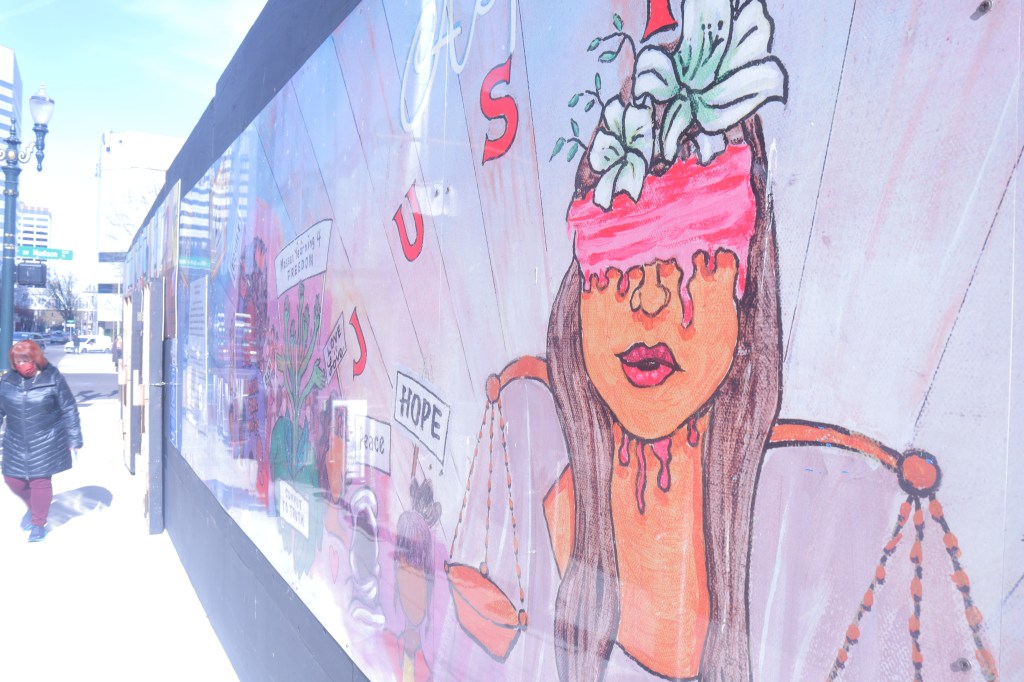
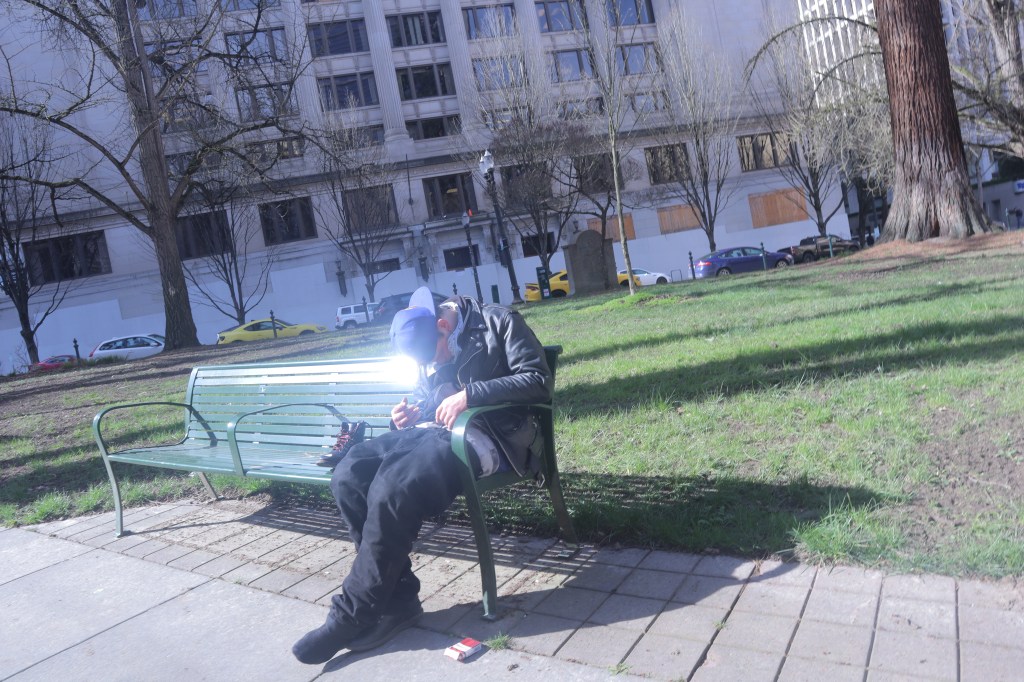
The same March sunlight obliterates the tattered grey clouds with the same brilliance as every year, oblivious to the city’s transformation. With blithe equanimity it alights upon the contorted maw of the schizophrenic no less than upon the fair face of the young woman going wide around him, and the same pure light graces the puerile black power murals as the occasional classic architectural line. Our world is changed, and the weather is indifferent.
PortlandiaMultnomah County Courthouse
Suddenly portable toilets are posted at intervals along the stretch of Barbur Boulevard south of downtown, appearing as if overnight. Here and there are pods of three–like banks of phone booths. One of these appears placed to service an encampment I’ve been watching sprawl up a wooded hillside for months. Days ago I saw a clean-up crew–one Mexican with a pickup–hauling garbage out with a wheelbarrow to his truck, a good quarter mile up the road.
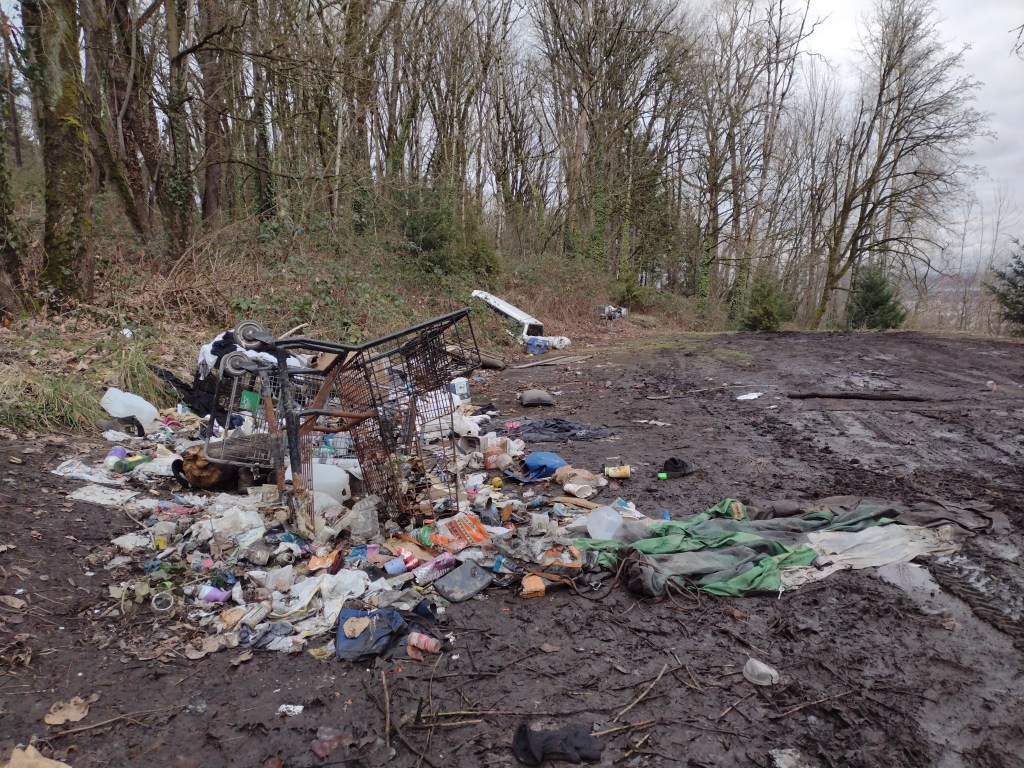
On the other side of the street past a broken vehicle gate there’s a dirt service road paralleling the highway just out of sight, abounding with heaps of refuse even the homeless no longer want.
The homeless are migrating down the highway out of downtown into Portland’s southwest, where they are still few. Before the one-two punch of Covid and BLM rioting the southwest’s conservative neighborhood association had been taken out by the city and activists, making way for the rezoning that will densify and diversify this calmer quadrant of the city–and make it more welcoming to the homeless.
The economic deprivation since has slowed the progressive/real estate developer alliance and their plans. Developments are going up all around downtown–such as the massive boomer basin for an “active 62-plus” clientele rising up in a grim forest of rebar nearby, that I whistle past like a graveyard–but these represent a clot of projects delayed by Covid, and the forecast is for less development, as downtown businesses continue to fall out even as the buildings go up. Yet the people still come, many abandoning the rural south of the state, and the increase in rental trucks I’ve been noticing lately aren’t escapees but arrivals.
The park blocks across from the still barricaded–new normal–Justice Center and federal courthouse, are empty and just a dozen or so tents with no visible human presence, the last stubborn trace of the occupation of 2020, line Main Street where the Elk Statue once stood.
From the advantage of his elevated position atop an obelisk the perpetually vigilant doughboy of the Soldiers Monument survives the iconoclastic racial reckoning; but he couldn’t save the good settlers of The Promised Land–promise broken, their pedestal remains with its inscription quoting Thomas Jefferson imploring settler and Indian alike to live in peace in the conquering but benevolent embrace of Uncle Sam.
“Cops Kill —>Cops” taunts the graffiti on the soldier’s obelisk, referencing a policeman killed by friendly fire recently. A junkie on the nod and I are the soldier’s only company.
Summer 2020
“Chris!” I called out. He was passing me by oblivious, hobbling along in the orthopedic boot he’s been wearing on his wrecked right foot for years.
“Oh hey Dennis.” He said in his lilting slur, turning his sleepy eyes on me, smiling. “How you doin’?”
“I’m alright. How are you? Holding up?” It’s been almost a year since he fell back onto the streets, after a respite of four months or so renting a room. His booted leg was mangled in a work accident, he says; he’s a carpenter. But I know he’s got a drug problem too. “You still over there?” I motioned north; he had been living in a tent pitched near a homeless center in Old Town where he could get food and an occasional shower or phone call.
“It’s rough here,” he said when I saw him there last year, “those guys over there are dealing” he indicated a tent-complex nearby where a fat black brother skulked. “Lot of crazy people out here.” He had been recently beaten up. “I’ve been in more fights these three months than in my whole life. These young guys will challenge me to fight,” he grimace-smiled, “and I don’t know how.” He laughed bitterly. “I never hit anyone in my life.” They were singling him out because he’s weak and makes for good practice, I thought; shit rolls downhill on the streets, I imagine, and one bullies one who bullies another. “I don’t know how to fight,” he complained. “I can’t even lift this arm over my head” he raised it weakly a quarter rotation to demonstrate. That was almost a year ago.
Today he told me he’s found a bed in a shelter; I know the place, near Union Station which, naturally, is rotten with homeless. It looks rough, I said. He nodded; it beats sleeping on the street. I noticed his right hand was swollen, and grotesquely at the joints; the skin was red-purple and taking on a sheen; the base of this thumb was like a small plum. The hand looked like a rubber prop. He noticed me appraising it.
“I got nerve damage. I can’t close this hand at all.” He demonstrated, weakly flexing the fingers. “I got beat up again, on Christmas.” He shook his head with a grimace. “They hit me with a bat,” he pointed at his right eye with his club-hand; his temple looks dented there, as if by a ball-peen hammer.
“Yeah” He said with morbid enthusiasm. “I’m all fucked up along here,” he indicated his side; “I can’t really see out of this eye…”
As always, with the same miserable grin he relates his troubles, shaking his head.
“Jesus. You need anything?”
“Nah.” He says, turning dark, as if delivering an unfortunate diagnosis.
“You want a smoke?” I ask. “What do you smoke, Marlboro Reds?”
“I smoke whatever,” he smiled.
“Come on, I’m going to buy you a pack of cigarettes so I can bum one.” He protests briefly but falls in as I head north. The wretched little 24-hour convenience store near an off-track betting place has been cleaned up a bit; the usual collection of the most wretched of the homeless is not occupying the alcove of the abandoned store next door. I chuckled bitterly at the price; how do the homeless afford it? Back out front I handed Chris the smokes and he gave me one back. I coughed a little drawing in the smoke along with the crisp air.
“You need a ride?” I asked.
“Nah.” He said, glumly; nowhere to go.
I watched him trundle north on Fourth Avenue, wondering, as always, if this will be the last I see of him.
“Hoy Dennis.” It was my neighbor Malachi and his Irish brogue. I was back home.
“Oh hey.” I said, putting my keys away. “How you doing?”
“Foine, foine.” He says. As we engage in small talk the subject of the homeless comes up–he’s read a recent news report that seventy percent of our record-breaking traffic fatalities last year were homeless pedestrians.
“I heard. I guess the mayor instituted a ban on camping near freeway onramps and the like, but he’s catching hell even for that. Can’t tell people where to live.”
“Yoo kneow what happened to my friend?”
Of course I don’t
“Ookay: hae’s over on —, by the —“; I pretend I understand, as it doesn’t matter. “Hae’s maykin’ a rooight tarn, yoo kneow, hae’s maykin a rooight tarn, yeah” Malachi tends to repeat phrases “end theare’s a boous theare, yoo kneow, a city boous, pulled up to a boous stop, yeah? end Bob, yoo kneow hae can’t see round it, yoo kneow? End hae goies to make his rooight tarn, coming round the back of the boous, rooight?”
Right, I nod.
“Soo hae’s lookin” he mimes someone with hands on the wheel looking over their left shoulder for traffic “foor carrs cooming, rooight?” Again I nod. “End hae poonches it, you kneow, thinking it’s cleer. Next thing hae kneows, Bob says, a homeless goy, a homeless goy hae din’t see–Bob was blocked boy the boase, hae din’t see–currashes into the windshield.”
“Holy shit.”
“Yeah. Yeah. Bob says the goy breaks the windsheeld en goes over the roof uh the carr en comes down on the raeer windsheeld taoo, en et breeks. Yeah. That’s heow hahrrd Bob hit him, yeah?” He pauses courteously to let me absorb this. “Soo boy neow Bob has het his breakes, only neow, yeah? end the poar bastard comes back over the roof of the carr! Over the roof of the carr, end lands in the street en frent of et!”
I let him know how impressed I am by this story.
“Soo thay call 911, yeah? end an ambulance takes the goy away. Noabody says anything to Bob, you kneow, and hae gooes ahome. But hae’s awooried, right? Hae’s awooried about this goy end hae mooight be in some trouble, yeah? Suoo, hae goes to the cops, yoo kneow, end hae tells em his stoory, right?” He pauses. “End thay tell him not to woory about it. Jest goa hoame thay say.”
“What about the homeless guy?”
“Hae’s in hospital. Hae’s in hospital, yeah. Thay din’t seay how hae is. But thay told Bob to goa hoame. Thay doan purrsoo these cases now, thay say.” He laughed. “Noo woories I guess.”
Dennis’ desultory YouTube channel is suspended until April for like, you know, disinformationing on the Covid yo, and Dennis gets a strike.
Regarding YouTube’s “strikes”: doesn’t it feel like the pitches aren’t in the strike zone at all? The pitch is over everyone’s head, into the bleachers, and an umpire with clown-hair spins in the air 180 degrees to land hard and emphasize: “steeeee-riiiike, queen!” Argue with they/them, get the hand.
Breaking Bad was a well-regarded television series about a middle-aged high school science teacher who becomes a drug lord after a terminal cancer diagnosis and a chance encounter with a former student, who he finds is now a petty dealer. The two, pointedly named White and Pinkman, boomer and millennial, share in common only whiteness and squandered potential as they team up to put the underemployed science teacher’s uncommon skills as a chemist to use producing high quality crystal meth.
Two themes prevail, first the well-worn trope nice guy goes alpha by going outlaw and, the means by which our beta breaks out, reason and logic prevail. Vulnerable and unskilled in violence while navigating the world of cholo gangs, Mexican drug cartels and outlaw bikers, protagonist Walter White repeatedly turns to inventiveness and ingenuity to prevail over his crueler enemies in a theme reminiscent of what Edgar Allen Poe called “tales of raciocination“: stories of individuals solving problems through the application of acquired knowledge. The film The Edge addresses the theme directly. The pair’s tragedy plays out in the tacky dullscape of post-white American decline, with New Mexico excelling in the role.
One storyline ends thus: the pair, who’ve found themselves first working for and then falling on the bad side of a more powerful drug lord–mixed race, black, vaguely Hispanic, of indeterminate nationality, emotionless and refined, a globalist cypher played by Giancarlo Esposito–who originally hired them to produce for him their market-dominant signature meth recipe. Esposito has captured them and has them tied to chairs in their meth lab.
Why shouldn’t I kill you, he asks. Because we’re the only ones with the know-how to produce the product you need, White says. Our international man of mystery then brings forward his loyal Mexican henchman, until now a silent assistant, who demonstrates the white guys’ procedure for them step-by-step. As obvious as the symbolism is here, I’d be willing to bet few good liberals among the show’s fawning critics got it.
Breaking Bad was a lament of white decline and celebration of white virtue that just made it past the censorious class by indulging their long-cultivated reverence for the anti-hero; to get them to cheer for the White Guy the author made the white guy a drug dealer and killer. Somewhere someone caught on and felt betrayed–here they thought they’d been innocently cheering on criminality, when it was whiteness the whole time!
While the density of critics must be presumed, it’s hard to imagine Bryan Cranston, who won raves for this brilliant portrayal of white rage and toxic masculinity, doesn’t see it. Perhaps that’s why he feels he needs to atone, er, “learn“:
“I’m 65 years old now, and I need to learn, I need to change.”
The words tumble with intensity out of actor Bryan Cranston’s mouth. He sits beside an unlighted fire pit in his backyard on a recent windy morning. Chimes ring mournfully in the breeze, and small white blossoms from a tree twist and twirl their way to a soft landing in the nearby pool.
Cranston is telling me why he chose to step away from an offer to direct a show at L.A.’s Geffen Playhouse and how that decision led him to take the role of Charles Nichols in the theater’s West Coast premiere of “Power of Sail,” written by Paul Grellong and directed by Weyni Mengesha, running through March 20.
As Nichols, Cranston plays an aging, highly respected Harvard professor who faces intense backlash for inviting a white nationalist and Holocaust denier named Carver to speak at his annual symposium. As student protests intensify, Nichols presses forward, claiming his intention is to give Carver and his repugnant ideas a thorough dressing down in a debate.
Two people named Grellong and Mengesha are lecturing Americans about the dangers of free speech, using respected actors as their marionettes (not that I expect the Geffen Playhouse need worry about crowds):
An avowed “free-speech absolutist,” Nichols says, “The answer to hate speech is more speech.”
“Power of Sail” had its world premiere in 2019 at the Warehouse Theatre in Greenville, S.C., but Cranston believes the play gained resonance in the wake of the pandemic and the social and racial justice uprisings following the murder of George Floyd.
As those occurrences shook the world, they also transformed Cranston, who says in these troubling years he came face to face with his own “white blindness” and privilege. It was necessary work for a man tasked with playing a character whose white privilege prevents him from seeing the very real harm caused by his actions until it is much too late.
I don’t know if Cranston can see it coming–if his “blindness” extends to actual reality or not–but if they should eventually come for Breaking Bad in their ongoing revision and cancelling of pre-woke works deemed problematic–virtually everything pre-racial-reckoning; and if they come to the same conclusions I have above, Cranston will be seen as just what he describes above: guilty of having caused real “harm” by acting out his “white privilege.” Whether he understands or not–but I suspect he does–his handing himself over to play the carnival geek for woke kitschmeisters is cheap insurance against personal and professional devastation later. Cheap for him; the cumulative effect of countless talented but mediocre people like Bryan Cranston abandoning art to pitch propaganda is very expensive indeed for the rest of us.
Cranston was set to direct a perfectly awful sounding play about an Englishman foiling a KKK plot, but likely saw the white savior genre as untenable post-reckoning; if things had stopped there we could say at least the present madness spared us that. Alas:
So he stepped aside, telling Shakman, “If you find a play that you need an old white guy to act in, then maybe I can be available for that.”
Cranston also stipulated that he wanted to be a part of “something that changes the conversation.” In his estimation, the measure of success in theater is always “Does the conversation continue after the play is over?”
For Cranston, “Power of Sail” meets that criterion with its pointed critique of America’s devotion to the primacy of free speech.
The play asks if there should be limits to free speech, and if so, why? It tests the boundaries of the free speech ideal by examining the traditional arbiters of that speech — those who get to decide whose voice is lifted and whose voice is quashed. It suggests the existence of a moral compass in an age when truth is often called relative by special-interest groups opposed to it.
Brandon Scott, who plays the Black academic Baxter Forrest in “Power of Sail,” tries to stop Nichols from hosting Carver at the symposium while citing 20th century philosopher Karl Popper’s “paradox of tolerance.” Popper’s idea is that if a society — in pursuit of tolerance without limits — tolerates the intolerant, the latter will eventually destroy that society.
Cranston is taken with the theory and leans forward in his chair while discussing it.
“There need to be barriers, there need to be guard rails,” he says. “If someone wants to say the Holocaust was a hoax, which is against history … to give a person space to amplify that speech is not tolerance. It’s abusive.”
Cranston and White are emblematic of a generation and its vanity. On television Walter White threw off his beta chains to die like a man; in reality Cranston draws the chains around him to live like a slave.
“Make yourselves ungovernable” is a favored slogan of rioting Portland anarchists. Through their activist organizational arms they walk this walk, making it as hard as they can for the city to maintain public spaces and basic services. Their advocacy on behalf of the homeless has for them the incidental if not deliberate feature of making the city less livable–Make Portland Unlivable would do for a chant–and contributing to their Marxian dreams of bringing it all crashing down.
In addition to January producing ten homicides Portland also reported a record year-on-year increase in traffic deaths that likely stems directly from the visible withdrawal of police from traffic enforcement, a result of their defunding, demoralization and understaffing–all frank goals of antifa and BLM. Seventy percent of those traffic deaths in 2021 were homeless pedestrians. A cynic might say the BLM movement in Portland, by achieving their goal of reducing police on the streets, has cost not only some black lives but a good many homeless lives as well.
And, naturally, if black lives must be sacrificed to Black Lives Matter, homeless lives must be sacrificed to their respective cause; the homeless must die so the “houseless” may live. After the traffic numbers were released Mayor Ted Wheeler announced a ban on camping along high-traffic dangerous roadways. Last year the city relaxed the rules and now allows tent and car camping virtually anywhere. Street sweeps clearing out camps are rare now and the city is providing hundreds more beds for the homeless and launching a plan to distribute small homeless villages throughout the area.
Nonetheless, asking people to camp somewhere other than a freeway onramp is just too much, in Portland:
“[We] strongly object to the emergency declaration to sweep encampments and further displace unhoused community members from alongside our most dangerous roads,” the letter reads. “The presence of unhoused people does not make our streets unsafe; rather poor roadway design, ongoing neglect and deferred maintenance, recklessness in the form of speeding, operating a vehicle while impaired by drugs or alcohol and other dangerous behavior are all well-documented reasons why there is this alarming uptick in deaths.”
Most notably, the letter’s signatories include several of the advocates who publicly decried the rise in homeless people killed crossing streets. That suggests the mayor’s office did not consult the groups closest to the problem—and that Wheeler’s ban is poised to become the latest political impasse in a city paralyzed in the face of a housing crisis…
The signatories of the letter today hint that Wheeler’s reasoning for the ban—what he’s publicly stated as a measure intended to better protect people living along major roadways—is an inappropriate way to decrease traffic deaths.
“Nowhere in any transportation study, advocacy campaign nor community forum seeking to address our roadway safety problems has it been suggested that unhoused people and encampments should be swept or outright banned as a partial solution to this crisis,” the letter reads…
Of course the answer to this crisis stemming from too few cops is fewer cops still:
The proposed safety measures include fully funding Portland Street Response, closing high-crash corridors to drivers as an emergency order and reducing the speed limit to 25 miles per hour on all city-owned roads, and increasing visibility at 350 of the city’s busiest intersections.
The letter also mentioned a legal precedent that the city of Portland has found ways to circumvent regarding when it’s legal to sweep people: the Martin v. Boise ruling in the 9th Circuit Court, which said that a government can only sweep people if there’s enough shelter for each individual. (There is not, by a long shot.)










 untethered