The Musk v The Megaphone

Many challenges to the neoliberal revolution from above–to “Globohomo“–have shown up confident in their logic and appeal only to end up absorbed in Globohomo’s vast and dense obtuseness like lost travelers in the Amazon. Consider the campaigns against CRT and “grooming”; heading into the midterm elections they’re winning–politically they’re irresistible–yet past experience suggests they’ll simply be outlasted, after Republican mid-term candidates and Fox News take advantage. Many a presumed breaking point has been passed along our way; many a bridge has proven not too far at all for Globohomo.

Globohomo succeeds in all its offensives and repulses all attacks, undefeated at home and away. But these wins are in ways fraudulent–logically unsound and popularly unappealing. So control of the media is essential. Team Globohomo gets to cheat because it holds the Megaphone.

No challenge was bigger than Trump’s election campaign and administration. From joyous optimism in 2016, through the disappointing slog of his administration, to the humiliating debacle of January 6–all with the effect of consolidating Globohomo’s power and ushering in our present endgame of censorship and repression–pessimism isn’t just understandable, it’s practically mandatory.

But Elon Musk’s challenge to Twitter by offering to buy it is cause for optimism. Despite underperforming for years now as it’s flailed about for a growth strategy (that doesn’t involve greater freedom of speech) and being the shrimp among the social media companies, Twitter’s influence, as an immediate global arena where anyone might reach anyone else, is immeasurable. Through content sharing on its platform Twitter is social media’s linchpin in a way her fat cat peers covet but can’t reproduce. Twitter practically is the Megaphone.

So Twitter being essential to Trump’s insurgency–with the added horror of Trump’s campaign enlivening the site and being very good for business–is a sin for which Twitter must atone. A belief shared by Twitter. The threat Trump revealed–of the site’s suitability for a genuine populist movement–remains, and Twitter is on notice, from within and without.

So “get woke go broke” isn’t necessarily untrue, it’s just irrelevant.

No one is trying to gauge how much censorship and its chilling effect is costing Twitter–justice knows nothing of opportunity costs. But the company’s refusal to consider Musk’s generous bid demonstrates Twitter is seen from within and without primarily as a speech moderating institution, not a profit-making venture. The company’s implied balance sheet in the economy of power is more important than their financials,

I think there’s an understanding within the company and board that Twitter will be given leeway–that shareholders won’t be roused by poor performance, for one thing–because of the company’s unique importance to the control of the media. Twitter is counting on something akin to the “Greenspan Put” indemnifying against losses; call it the Woke Put. But those pesky investors, like voters and citizens, remain out there.

Musk’s wealth has put him in a position to at least force Twitter to publicly impoverish its shareholders and–hopefully, if Musk mounts an investor revolt–to be seen fighting savagely (and I do expect that) against profitability.

https://platform.twitter.com/widgets.js

No one has been more vociferous in opposing Musk’s meddling in Twitter and in defending censorship generally than The Washington Post, of course. Here’s an example:

Elon Musk’s vision for Twitter is a public town square where there few restrictions on what people can or can’t say on the Internet.

But the utopian ideal envisioned by the Tesla CEO ceased to exist long ago and doesn’t take into account what’s happening in the real world, tech executives, Twitter employees and Silicon Valley insiders say. As Musk seeks a $43 billion hostile takeover bid for Twitter, critics say his ambition for what the platform should be — a largely unpoliced space rid of censorship — is naive, would hurt the company’s growth prospects and would render the platform unsafe.

Typically this type of “but some say” article looking to shoot down something like Musk’s little adventure here is bogus, citing a few people in activist organizations who would be completely irrelevant if they weren’t quoted in such articles, but in this case the cited represent the mood of a good section of Twitter itself. The article quotes Musk:

“My strong intuitive sense is that having a public platform that is maximally trusted and broadly inclusive is extremely important to the future of civilization,” he said.

That’s self evident enough to be a platitude. But hold on a second, The Post responds:

Some pro-free speech networks have been found by researchers to be havens for white supremacists and those who wished to harm society.

Perhaps it’s important to understand the censorship of “white supremacists” isn’t just about censoring white supremacists–we are few and powerless–but using the bogey of white supremacy to establish the principle that speech must be limited. White supremacy exists, ergo, the First Amendment is obsolete, is the argument.

White supremacy is not a real thing. The First Amendment is less and less a real thing–selectively applied any law becomes a lie–because of the bogey of white supremacy. And this is how one lie is made to produce another.

Elon Musk might get to Mars before we get to freedom–the former is a problem of physics, whereas the latter is a problem of evil. Physics problems have answers.

But today is a better day because of Musk’s crusade.

PDX Diary April 15: Raggedy Androgyne

Portland’s downtown library is open to the public again, no mask requirement. There are no padded chairs or sofas, too inviting to homeless, just high backed wood chairs lining long narrow wood tables. They’re not too bad though; you can lean back and work in them in surprising comfort and there are plenty.

Across from me a young homeless man is telling his story to a young female librarian. Occasionally one of the librarians sweeps through wearing an N95 mask, grim and wraithlike. A homeless guy, obliviously voluminous, has convinced them to lend him the phone at the librarian’s desk in the high-ceilinged room–rose colored with great high arching wood vaulted windows flashing bands of cloud-traversed sky–and he’s well into a meandering conversation. Two librarians have joined one behind the counter to stand by miserably waiting for the right point to intervene.

I decide to browse the books and find social sciences well stocked with progressive tomes; a whole bank of black grievance kitsch beckons, obliviously condescending, histrionic, hectoring and humorless, an obtuse obelisk. At one of the tables nearby is a person; he’s wearing dolphin shorts and a tight girl-cut tee shirt with some sort of harness or belt around his fat middle. His pixie-cut hair is a pastel sea foam color. His enormous, girlish thighs are covered in a fine hair that doesn’t look right; my God, are they dyed? I refuse to look directly at him. I see him fidgeting about conspicuously in my peripheral vision, as if trying to get my, or anybody’s, attention. I move on, resisting the seductive leer of the latest Michael Eric Dyson.

In the lobby on the way out a frail masked librarian is solemnly shadowing the loud-talking phone-borrower; it seems she’s made progress in coaxing him toward the exit. This is the low-key method I’ve seen them use–from my few days haunting the place–to deal with the low-key harassment of the homeless. Low-key harassment and passive aggression have become trademarks of our parasitic class, taking advantage of our increasingly permissive stance.

I pass out the foyer and off to my right someone appears to be receiving counseling sitting at a sort of low ticket-window; he’s animated about something. The weather is as ugly as the city for a change I think as I take in the scene in the little bleak corner where the library is. It’s offensively cold and little hard drops of rain half-frozen pelt me as I squeeze past a construction crew fixing a section of sidewalk and the crazy black woman engaging them with low-key harassment.

Later I’m on the other side of town and I see him: he’s running with his arms crossed tightly in front of him–it’s the gender-strange guy with the sea foam hair–and, my God, what is it he’s got under one elbow? Is that a small dog? I wonder with alarm, because whatever it is, its head is slapping back and forth violently–obscenely–as he skip-runs along in exaggerated female fashion. He’s running at an angle across the empty intersection, and the few other people on the street take no notice of this giant–that’s it, I realize, that’s the aesthetic he’s going for!–Raggedy Ann skipping across a downtown street in the middle of the day, barely dressed in forty degrees.

Then I noticed what it was he held, tightly between his arms crossed in front of him–deliberately mimicking the way of a young girl: a Raggedy Ann doll.

Well that’s a relief. At least no animals were hurt in the making of this madness.

Murder Mystery

The Daily Mail asks:

Why did take more than 29 hours to find and arrest James? 

As recently as Wednesday morning, James got on the train again at 9:15am in Park Slope and traveled into Manhattan, right under the noses of the doubled number of cops on trains.

It wasn’t until a member of the public noticed him in a McDonald’s and called police that he was finally arrested at 1:42pm at St Marks Place and First Avenue. 

Photos taken earlier that were posted on social media show him strolling around in a hat, mask and dark clothing.

James has a long rap sheet with charges in New York and New Jersey dating back to the 1990s for possessing burglary tools, criminal sex acts, criminal tampering, trespassing, larceny and disorderly conduct.

It’s still unclear why it took 24 hours to apprehend James, and how he was able to seemingly walk around in plain sight. 

The article goes on to portray the general ineptitude of New York’s authorities and its failing infrastructure–people locked in subway cars, security cameras not working–and the understaffing of subway cops.

So with all the incompetence presided over by an appropriately inept black mayor sheltering in his basement with Covid, it’s hard to answer the Daily Mail’s question. But here’s a possible contributing factor from Steve Sailer:

But do New York Times readers, many of whom live in New York and need to be on the look out for this dangerous maniac on the run, know that? You’d have to read pretty deep into the NYT’s coverage to find a picture of the shooter.

Here are all the images that the NYT has posted higher up in their coverage than the picture of the wanted desperado.

After one scrolls a yard or so down the NYT article through photos of everything but the black power terrorist on the run, if he doesn’t get bored and move on:

And then, finally after 1,563 words, 8 photos, 2 videos, and 1 custom-made map, we get a picture of the shooter on the loose:

The NYT still can’t bear to use the word “black” to describe the gunman:

Mr. James remains at large, James Essig, the Police Department’s chief of detectives, said in a news conference at police headquarters.

“We are endeavoring to locate him to determine his connection to the subway shooting, if any,” Chief Essig said.

He appeared to have posted dozens of videos on YouTube, where he riffed off news events in long, vitriolic rants. He blamed Black women for violence among Black people and pointed to Russia’s invasion of Ukraine as evidence that whites are genocidal.

Shortly before 8:30 a.m., the police said, a heavyset, dark-skinned man in a construction vest and construction helmet donned a gas mask as a crowded N train approached the 36th Street station in the Sunset Park neighborhood, tossed two smoke grenades on the floor of the car, and began firing the gun. Thirty-three shots later, he fled.

Perhaps the earnest wokals at the NYT can make themselves feel better about enhancing public safety if they just lose the reverential capitalization of “black” when describing dangerous lunatics on the loose. They can justify it with a version of the No True Scotsman fallacy–No True Negro would shoot up a subway station.

Note how the shooter incorporated the Ukraine narrative into his analysis. Everyone one of us now is his own little narrate-o-matic.

update:

https://platform.twitter.com/widgets.js

Double Plus Orwellian

I resist the urge to dismiss any public figure as an idiot, because it’s too easy, too tempting for me, anonymous nobody; also, holding a high perch in the scrum of American public life, however stupid that life has become, must be the product of at the least uncommon cunning. In all honesty, the Right Stuff for success in today’s world, much like yesterday’s, appears to me like technology appears to a primitive. It might as well be magic. So I resist opining on it. But it gets hard.

The old saw never attribute to malice what which is adequately explained by stupidity feels not so wise now and a little subversive, letting the malicious bastards off the hook. Let us turn that bit of folk wisdom from a more innocent time on its head, because of all the malice we abound in, if nothing else.

Still, condescension, malice’s unctuous representative, is inherently stupid, and here’s Robert Reich being condescending in The Guardian, explaining how Elon Musk threatening to establish free speech on Twitter is actually a threat to free speech:

The Russian people know little about Putin’s war on Ukraine because Putin has blocked their access to the truth, substituting propaganda and lies.

This is line one, and we see how Putin has been made into an avatar for virtue-seeking malice just like Trump, and the war in Ukraine a proxy in the war on populism.

But one idiocy at a time. Even taking for granted effective state censorship in the post-Soviet Union, one has to wonder if the average Russian gets a more or less distorted view of the war than we do. For one thing, Russian media is blocked here, so how would we, or Reich, who would never deign read it, know? It’s an open question as to whether Russian state censorship is more effective than our very effective private sector version.

It’s no longer obvious the average citizen in the US lives in a more open society, and clearly in many ways he lives in a society that is less open. And who is censoring, private or public, is far less important than what is being censored. In Russia you can’t criticize the government too much. In America you can’t criticize Drag Queen Story Hour, at all.

Russia doesn’t have classes of citizens acting as social media minutemen, always scanning the field and ready to mobilize–no need to summon them–to chase off wrong-speak; Russia doesn’t have the equivalent of the woke cadres within social media companies forcing censorship; Russia, presumably, doesn’t have mobs in its best law schools shutting down panels on free speech. Russia has state-controlled media and we have media controlled by a vaster power, superseding the state; its apologists invoke plausible deniability of its control by virtue of it being more complex, decentralized and disordered–and “private”. Most importantly, Russian propaganda–ironically enough–is not revolutionary, deliberately upending society in fundamental and disastrous ways.

That strange sound you heard when news of Musk’s Twitter stake hit was the “it’s a private company” excuse for censorship choking in the collective throat of woke America.

Here we censor thought, explicitly to prevent future dissent as if to pull it out by the root, explicitly to prevent further thought. The relative freedom of Russian and Western internet is meaningless to us of course–people who want you angry about Russian censorship, like Reich, don’t give a damn really about Russian censorship, and neither should you.

From Freedom House:

In March 2021, the [Russian government] communications regulator throttled access to Twitter after the company refused to block “prohibited content,” with the government claiming that the content in question included material related to drug use and suicide. This marked the first time that deep packet inspection (DPI) equipment installed under the scope of the 2019 Sovereign Runet Law was applied to block a global online platform.

The government issued fines and passed several laws in an attempt to exercise control over the content moderation policies of popular online platforms, culminating in the introduction of a law on local representatives. The law, adopted after the coverage period in July 2021, will require these companies to establish in-country offices that liaise with the federal agency responsible for censoring content.

During the mass protests in support of Navalny that began in late January 2021, the authorities limited the space for online mobilization, arresting individuals who promoted the protests and raiding the office of a student-run online media outlet.

In a departure from their strategy in previous years, Russian authorities did not shut down internet service during protests (see A3).

Cue the Soviet-era Russian accent: in Russia, government throttles Twitter; in America Twitter throttles you.

Freedom House says its 2016 ranking of Russia’s internet as “not free” came after five years of Putin ratcheting down on dissent–coinciding with the period of our ratcheting up the pressure on Putin with Maidan and Navalny.

Here’s Robert sounding like Kamala Harris explaining Ukraine to black people:

Years ago, pundits assumed the internet would open a new era of democracy, giving everyone access to the truth. But dictators like Putin and demagogues like Trump have demonstrated how naive that assumption was.

Pundits like Reich assume above all their right to control the public’s access to information, and their naïveté was only in thinking the internet wouldn’t get in the way of that. But note how Reich argues the internet must be controlled–by his tribe–because it’s threatened by dictators at one end and populists at the other.

At least the US responded to Trump’s lies. Trump had 88 million Twitter followers before Twitter took him off its platform – just two days after the attack on the Capitol, which he provoked, in part, with his tweets. (Trump’s social media accounts were also suspended on Facebook, YouTube, Instagram, Snapchat, Twitch and TikTok.)

These moves were necessary to protect American democracy. But Elon Musk – the richest man in the world, with 80 million Twitter followers – wasn’t pleased. Musk tweeted that US tech companies shouldn’t be acting “as the de facto arbiter of free speech”.

It’s astounding to me the January 6 riot at the Capitol isn’t understood in its proper context, as the culmination of the season of anarchist rioting kicked off by the George Floyd protests. The far less organized and politically sophisticated right wingers were adopting the methods and mayhem they’d been watching antifa and BLM get away with for months.

But then we get to the real offense:

Musk continues to tell his 80 million followers all sorts of things. I disagree with many of his positions, but ever since I posted a tweet two years ago criticizing him for how he treated his Tesla workers he has blocked me – so I can’t view or post criticisms of his tweets to his followers.

Seems like an odd move for someone who describes himself as a “free speech absolutist”. Musk advocates free speech but in reality it’s just about power.

Is it about power? Vanity, certainly. If Musk wants to white night on behalf of freedom of speech I approve. But power? Jeff Bezos buying the Washington Post and making it his mouthpiece is about power. Does anyone think Musk intends that for Twitter? That Twitter is the best vehicle for that? That he’s going to go in there and re-jigger the algorithms so they censor on his behalf?

Must we block Musk to avenge Reich? Seriously, I think a Reich so misunderstands a Musk, so misunderstands anyone who hasn’t spent their life in the orbit of state power, that he cannot fathom Musk’s move other than as a power play. He cannot fathom a man engaged in an honest crusade: he must want more, he must want to take over control, not end it. But it doesn’t matter; the honest crusade is enough:

Power compelled Musk to buy $2.64bn of Twitter stock, making him the largest individual shareholder. Last week, Twitter announced that Musk would be joining Twitter’s board of directors, prompting Musk to promise “significant improvements” in the platform.

Sunday evening, though, it was announced that Musk would not be joining Twitter’s board. No reason was given but it’s probably part of a bargaining kabuki dance.

Musk wouldn’t have plopped down $2.64bn for nothing. If he is not on Twitter’s board, he’s not bound by a “standstill” agreement in which he pledged to buy no more than 14.9% of Twitter’s stock. Musk now faces no limit on how much of Twitter’s stock he can buy. He’ll buy as much as he needs to gain total control.

What “improvements” does Musk have in mind for Twitter? Will he use his clout over Twitter to prevent users with tens of millions of followers from blocking people who criticize them? I doubt it.

Will Musk use his clout to let Trump back on? I fear he will.

Keeping Trump off Twitter is very important to people like Reich right now.

Musk has long advocated a libertarian vision of an “uncontrolled” internet. That vision is dangerous rubbish. There’s no such animal, and there never will be.

Not if little Robert Reich has anything to do with it.

PDX Diary April 11: Ladyboys in Hell

“Just a couple of kids necking.”

“Boys or girls?”

–Dirty Harry

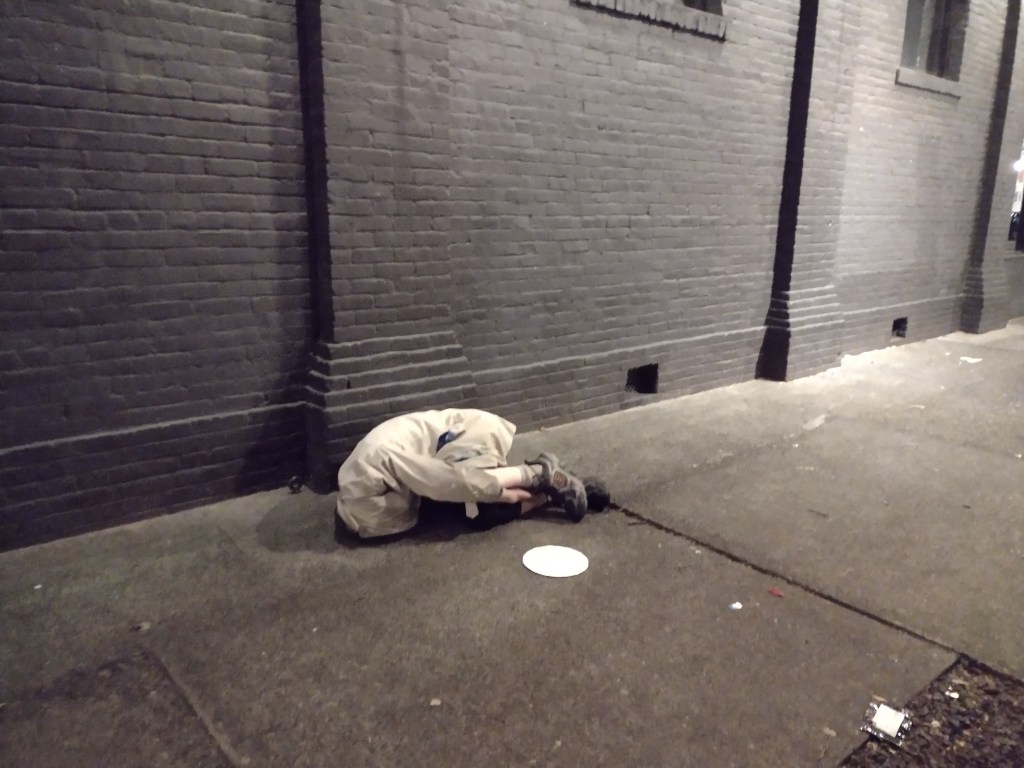
At the moment it’s unseasonably cold in Portland; snow on the ground this morning. Slush falls now as the temperature rises, and occasionally a clump of snow loses its grip in the trees outside my window and falls with woeful grace to the ground.

Days ago it seemed spring was here in full. I was outside, enjoying the light, and even I couldn’t help but take a good picture. As every year it seemed as if more women flooded the streets overnight, released from some subterranean place, blossoming in delightful variation, as the clothes lightened up with the weather.

This favorable aspect of spring was in effect and lifting, along with the light, the air of our battered downtown. But the people are fewer, still, than before the one-two punch of Covid and the post-Floyd racial reckoning set in place our new order, maturing into its third season, and even fewer are the best fauna of spring, young heterosexual women not yet ruined. With despair I look back over the last decade to see this species is on the wane, giving way to the invasive: sluts, lesbians, asexuals, trans “men”.

Fashion in female dress is fracturing around social identities, from sluts who can’t dress provocatively enough to young women who can’t dress far enough down. This latter category I think I’ve seen increasing over recent years–young women who may or may not be straight, aren’t obviously gender-confused, and dress like adolescent boys. I’ve developed my own half-assed theory: this is an adaptation, like much gender confusion, to the ruthless nature of the sexual revolution in its maturity, existing at one end of a spectrum from its polar opposite, the half-dressed slut. One embraces and the other recoils from our sexual free market and its hierarchies. The sexually absented now–young men and women living lonely lives isolated from one another, incels male and female–choose quiet poverty over repeated ruin in a sexual free market that values them little.

I have a hard time accepting that under the purple hair and nose rings and rashes of tattoos, that walking arm-in-arm with their same-sex different-race “partners” (boyfriends and girlfriends are passé) are the same women who a generation ago would have been normal and–God forbid!–available to their respective racial, heterosexual male counterparts (and note how vastly more women have been changed by the sexual revolution than men); but it’s true. We lost our women and thus lost our world.

But there’s a new seasonal invasive I noticed when spring did its little head-fake last week; not a degenerated female but a fake one (I can’t help but recall one summer in boyhood when Japanese beetles just showed up out of nowhere, a brand new pest; glossy green flying monsters, buzzing sinisterly, that I found terrifying and would bat over the back fence into a rival’s yard with an old tennis racket).

The new species are young trans “women” appropriating the role of the spring girl described above. I realize I’ve seen plenty of ladyboys walking about at night, but not in the day–not that they’re not there, but they don’t register as much because, I think, they don’t dress up in the day. But this year I noticed several, bravely and awkwardly offering their various interpretations of femininity with a newfound boldness in dress–determined or emboldened more than ever to “pass” as women. All of a sudden they’re here–this is one day’s impression, so perhaps I’m being silly–and the sight of a pair of spindly boys in heels and hot pants, their hip-less male outlines giving them away at a distance, undiluted by the crisp spring sunlight, is jarring for its novelty–novelty I fear will be worn away by familiarity.

It seems there’s nothing the new order can’t ruin.

Masks and Mediocrity

From Covid-19 and the Global Predators:

Decades ago, In Crowds and Power, Nobel Prize Winner in Literature, Elias Canetti, wrote astonishing passages about the negative effects of wearing masks in general:

People’s attitude to this play of the features varies. In some civilizations the freedom of the face is largely restricted; it is thought improper to show pain and pleasure openly; a man shuts them away inside himself and his face remains calm. The real reason for this attitude is the desire for personal autonomy: no intrusion on oneself is permitted, nor does one intrude on anyone else. A man is supposed to have the strength to stand alone and the strength to remain himself. The two things go hand in hand, for it is the influence of one man upon another which stimulates the unending succession of transformations. They are expressed in gestures and the movements of the face and, where these are suppressed, all transformation becomes difficult and, in the end, impossible.

The different cultural attitudes toward masks between East and West have been noted and it’s hard to resist seeing in them the very different role personality plays in our respective societies. When I was more of a Western chauvinist I used to like to say the West invented personality with the novel and, especially, cinema. Transferring onto the silver screen the close-up–what an innovation in idolatrous human objectification!–wherein the most subtle human expression is made, dare I say, god-like, is one of the vectors by which modernity and technology have altered us. For better or worse the West made a thing of the objectification of personality.

But this invention is no accident and an expression of the individualism, and attendant egotism, of Western man. Witnessing the extent to which many came to and still embrace masks makes me wonder what element of that embrace goes beyond social signaling and genuine fear, and to what extent people are choosing masks to check out of an American society wherein personality is more objectified and commodified than ever; where even facial expressions are monetized, along with oversized asses and abs. This seems a sacrilege: the face expresses the soul.

With sympathy I suspect there’s a desire to want to preserve one’s psyche by pulling out of a society that feels like continual competition and humiliation. The endless images of people better-looking and happier come as an affront to one’s self-image. In particular I imagine this is hard for young people still forming adult personalities in the madness of present day America. America is a psychic charnel house. I think the appeal of becoming “gender non-conforming” for many young people is an escape from the carnage of the sexual market.

But that’s the sympathetic take. The mask also shields from view facial expressions–and facial expressions can “give us away”. There is a fundamental dishonesty in the mask, from the Western point of view; it conceals and assists in lying. Imagine the absurdity of any negotiation conducted behind masks (and I imagine our present elites doing just that)! The mask is a barrier to understanding that serves both the timid and the untrustworthy. Canneti:

A little experience of the inflexibility of such unnatural “stoics” soon leads one to understand the general significance of the mask: it is a conclusion; into it flows all the ferment of the yet unclear and uncompleted metamorphoses which the natural human face so miraculously expresses, and there it ends. Once the mask is in position there can be no more beginnings, no groping towards something new. The mask is clear-cut; it expresses something which is quite definite, and neither more nor less than this. It is fixed; the thing it expresses cannot change. …

A mask expresses much but hides even more. Above all, it separates.

That separation isn’t just the political one we see around masks. It’s also the individual, worn-down but still constantly assailed by a culture of comparison, endless comparison, who seeks to separate himself from a society that is disintegrating.

PDX Dispatch April 4: Woman Down

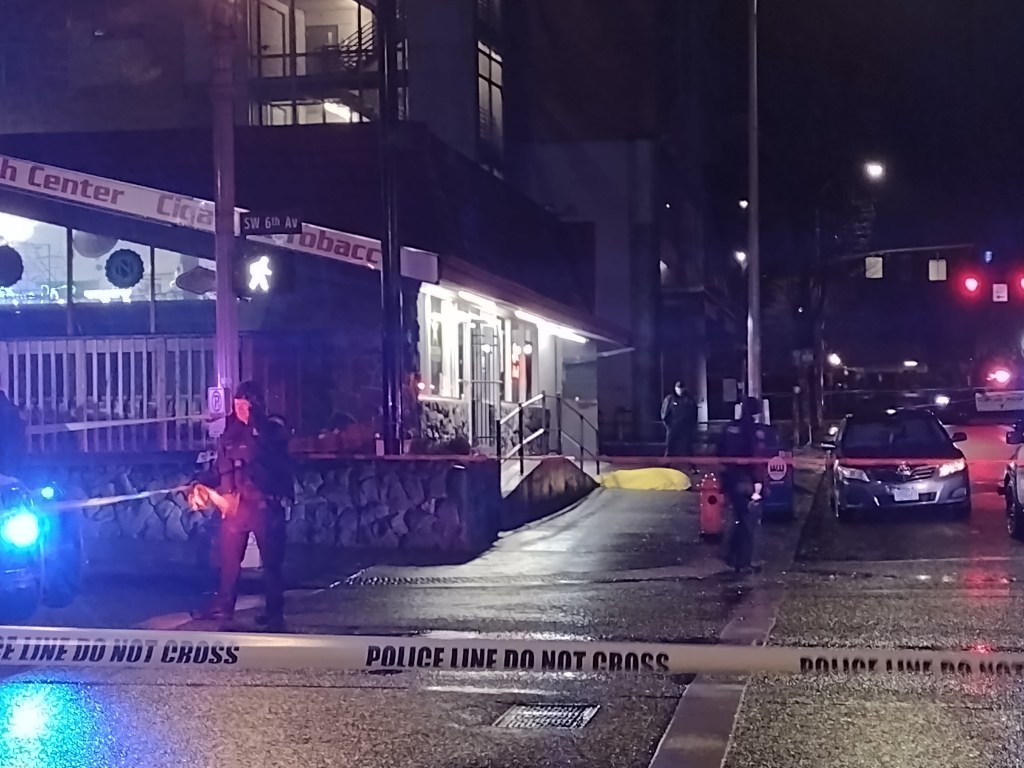
Around half past one this morning I came upon a crime scene at the south end of downtown, just outside of Portland State University.

“Is that what I think it is?” I asked a guy standing away from the tape talking to a little Mexican cop.

“Yeah.” He smiled sardonically. “Don’t you love Portland?”

The police tape howled in a low sinister drone, holding up somehow in the gale-like wind that had set in late Sunday night. The body was under what looked like a yellow tarp.

A big, impressive looking cop with a shaved head was brought over to the tape to hear a woman’s story of what she saw. His manner was casual. I asked a young man standing nearby if he saw what happened.

“Yeah.” He said. “I heard shots from my window and I came over to look and,” with the slightest nervous tremor in his voice “a guy was standing over the guy on the ground, and he shot him, bam, bam, bam, and took off.”

“Jesus.”

“Then he, or somebody, came back and he was checking him, like you know, to see if he was okay maybe?” he held his wrist; he was trying to say “check his pulse”, but couldn’t come up with the words at the moment. “Or he was just, I don’t know, going through his pockets.”

I took a snippet of video before a relatively cheerful female cop told me to shut it down.

Checking the news this morning I learn the victim is female.

PORTLAND, Ore. (KOIN) — A woman was found dead after a shooting in downtown Portland early Monday morning, officials said.

According to Portland police, officers responded to a report of a shooting around 1 p.m. at SW College Street and SW 6th Avenue. Officers reportedly found the woman deceased…

Portland State University released a statement about the shooting later in the day, saying the school community is “saddened to learn that the epidemic of deadly gun violence that has plagued so many cities has hit close to home.”

“PSU prioritizes the safety and well-being of our students and employees and our Campus Public Safety Officers are in contact with the Portland Police Bureau which is leading the investigation,” the statement read. “We don’t have further information about the incident at this time and there is no ongoing threat to our campus.”

Update: a 20 year-old suspect has been arrested.

Update II: The victim has been identified as a 19 year-old woman.

Reconstruction 2022: The Slap and the Pap

The slap in context.

The civil rights movement has been dubbed “the second Reconstruction”, atoning for the first, the failure of which convention attributes entirely to southern white racism.  And while the civil rights movement is deemed by that same convention as an unqualified success (that is nonetheless never-ending and always incomplete), the insane histrionics that go as civil rights now are due at least in half to the wild expectations those histrionics cultivate in black Americans.  Those expectations are that they should live as royalty. 

As a racist, I see those expectations as originating ultimately in the black American character, not in the propaganda that flatters it. Even modern full-spectrum propaganda has to choose its seed for the given soil.

As the civil rights movement/second reconstruction failed to close racial disparities and release all that dammed-up black genius (one of the movement’s early promises was to bring online all that “underutilized” talent) its narrative adapted to keep the movement–now an industry and state religion–going. The racial looting of “equity” displaces the meritocracy of “equality” and the least appreciated racial disparity is between how whites lean (equality; fairness) and how blacks lean (equity; gibs).

For blacks, equality-as-equity is not just equal distribution but the settling of historical scores.  It’s been said the average slave in the south thought that liberation meant he would henceforth live a life of leisure, like his erstwhile masters; this is understandable as his world didn’t go beyond the plantation. Black people, fed a steady diet of demagogy from the cradle, and like most people, view equality in the way of the poor woman in the story about the French Revolution: I suppose we’ll all be equal now, a lady asks her; yes, she replies, from now on I’ll wear finery and you’ll go about in rags. Critical race theory holds American whites lived as a sort of royalty on the backs of blacks, until the civil rights movement–the Second Reconstruction–set things right–not equal, but right.

But there’s more: black people are naturally more dominant, more prone to megalomania and sociopathy, and more reverential of brute power. Black society reflects that, in, among other things, raising up thousands of little tyrants, especially in entertainment. Black entertainers now are to black Americans as British royalty is to Britons–except with a far higher level of genuine admiration.

The unique circumstance of black overrepresentation in culture, in sports and entertainment where black charisma has–disastrously I say–seduced the nation, contributes to black feelings of superiority. This, combined with the gaslighting convention that black mediocrity everywhere else is a result of white malice, gives, understandably, blacks (and duller whites) the impression that blacks are a sort of master race–equal at least where they are not obviously superior. A chosen people–chosen by the Chosen, but that’s a longer story.

It’s almost inconceivable to the conventional thinker (what with all the propaganda) that not only might blacks be less predisposed toward liberalism and democracy, they might be predisposed toward their opposites–that is blacks might be predisposed to the way they are.

Black America now is not the product of oppression but of indulgence. This indulgence is taken by blacks as more confirmation of their royal status. In modern black lore every black woman is a queen and every black descended from royalty.  Nearly every hip hop artist is a self-styled tyrant king–America is littered with aspiring Big Men in the African style

Black people keep telling us but we refuse to listen: they are kings, not democrats.

Volunteer brigades of acolytes on social media combine with the mainstream press to defend black public figures from a sort of lèse-majesté that is invoked whenever we are prompted to outrage because so-and-so dared criticize black so-and-so(!). Those forces rallied to defend Will Smith for slapping Chris Rock on stage at the Oscars–a ceremony I and the few people I talked about it with did not know had occurred until Will’s slap hit the news.

The ceremony had been handed over to a black producer, in keeping with the current “racial reckoning”. The show was to be a celebration of black royalty. Will Smith was escorted to his place of privilege near the stage (conveniently enough) with his wife Jada looking like a Chinese dowager empress, sitting erect and imperious in a gown with a massive train, communicating with her icy glare we are not amused by the tepid joke of court jester Chris Rock. Smith was put on the spot, as a black American royal with black America’s expectations beaming through the dead-eyed glare of the Bond villain looking creature he would have to take home later.

It’s not just irony that the young Smith went as the “Fresh Prince”; the title was a good-natured sendup, when such was still possible, of the same black regal culture that produces murder and exploitation. Smith has made the journey along with the movement; he’s real royalty now and royalty is a sort of confinement of expectations and limits. The Fresh Prince is dead, long live the new Prince. (Let us not forget the juvenile aesthetic of Prince, and his royal purple.)

Who can blame blacks for thinking they are a class of royalty?  Who can blame them for thinking it’s their country? From the composition of advertisements on television and the internet now one would get the impression America was peopled mostly by blacks–and this is not new, foreigners have long vastly overestimated the black American population because of overrepresentation on television. I saw a banner ad for sun-block online recently–of course the model was black. And the cliche is true: these television blacks are amazing: intelligent, kind, generous, oh-so-patient with the hapless whites they encounter.

Now it’s funny, and you should laugh; but it’s also a sin, and you should wish those behind it a humiliation equal to ours.  And I’m not talking about black people.

Smith was handed the Oscar for his lead role in, wouldn’t you know it, “King Richard”. The standing ovation sanctioned his actions.

I have no idea if his acting was any good. But an amateur performance is worth noting here. Just as the Oscars were handed over to black America (and comically fell apart) a seat on the Supreme Court is being handed over to a black woman in recognition of her noble birth. Cory Booker’s paean is something to behold, as he deplores the “shocking” treatment of being questioned, like a mere commoner.

Black Lady Judge is a queen.