
Columbia University is paying a student 395,000 dollars to settle a lawsuit claiming he was unfairly suspended for spraying a group of pro-Gaza protesters with a noxious chemical.
Columbia University has reached a $395,000 settlement with a student who was suspended in January after spraying student protesters with a foul-smelling substance at one of several campus demonstrations in support of Palestine.
The Israeli student who received the payout had been suspended until May.
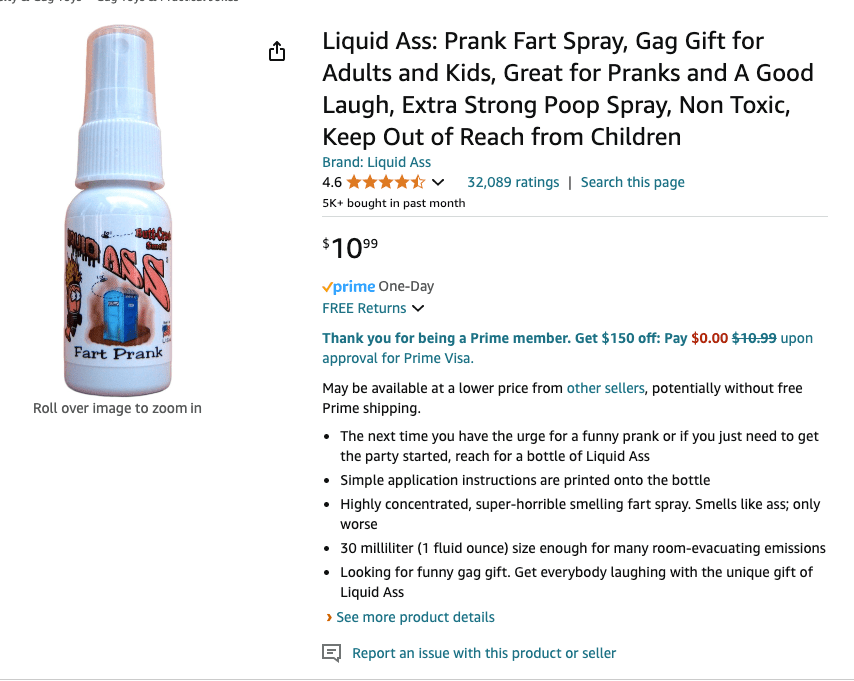
The case was first described as a possible chemical attack involving the use of skunk spray, an agent developed in Israel and used as a crowd-control weapon, most commonly in the Israeli-occupied West Bank. But Columbia has said the spray used was novelty, non-toxic fart spray, bought on Amazon for $26.11, and not a chemical agent.
“Liquid Ass” is available on Amazon, of course.
It’s also used for realistic training in the medical field and military:
Liquid Ass even made its way into military training operations, as Mary Roach describes in her book Grunt. It’s a key ingredient in fake bowels filled with dyed oatmeal, used in a device called a Cut Suit, a creation of a training company called Strategic Operations in San Diego, California which trains some members of the US military. The Cut Suit is a wearable prop that realistically mimics wounds; it starts off looking like healthy skin, and when you cut into it, it looks and smells like a real body would if it were cut open. The suits have been used, for example, by Navy medics practicing attending to wounded soldiers during an ongoing battle.
“Skunk” is the name for the more noxious “malodorant” the IDF developed for use on protesters and is sold abroad for use in crowd control, including in the United States.
Skunk is liable to cause physical harm, such as intense nausea, vomiting and skin rashes, in addition to any injury resulting from the powerful force of the spray. Examinations by police and army medical teams in the past also indicated that the excessive coughing caused by exposure can result in suffocation.
Apparently there’s no market in India for it, because, you guessed it:
A bomb that smells like sewage and was intended to be used on protesters in Kashmir and elsewhere has been found to be a dud. Reason: the “high threshold of Indians to tolerate stench”.
Skunk is deployable in projectiles. In October the IDF deployed some sort of malodorant using tank rounds against Irish UN peacekeepers in Lebanon.
At around 6:40 a.m., peacekeepers at the same position reported the firing of several rounds 100 metres north, which emitted smoke. Despite putting on protective masks, fifteen peacekeepers suffered effects, including skin irritation and gastrointestinal reactions, after the smoke entered the camp. The peacekeepers are receiving treatment.
It was January 19 of this year when the Columbia protesters were stink-bombed.
During a rally on Friday, according to attendees, two individuals sprayed a hazardous chemical that released an odious smell. Dozens of students have reported an array of symptoms, such as burning eyes, nausea, headaches, abdominal and chest pain, and vomiting.
The campus chapter of Students for Justice in Palestine publicized the incident on Saturday morning, identifying the substance as “skunk,” a chemical weapon used by the Israel Defense Forces against Palestinians and one that U.S. police departments have reportedly acquired in the past. SJP also alleged that the assailants have ties to the Israel Defense Forces, a claim that The Intercept could not independently confirm.
CSP students’ allegations will not get a hearing now that the lawsuit is settled.
Columbia eventually identified one of the alleged assailants and suspended him until May of next year. Soon its Task Force on Antisemitism, formed on November 1 2023 and headed by three Jewish professors, took up his cause, writing up a sort of amicus brief for the suspended student, arguing the charges were unfounded and the punishment excessive.
The task force continues its work but isn’t going to tie itself down by actually defining antisemitism.
The task force is not going to parse words on the definition of antisemitism but will take an “experientially oriented approach,” Fuchs said. She added that they would not delve into which of the “25 definitions of antisemitism” the group would subscribe to, because “that’s not the purpose of what we’re doing.”
They’ll know it when they smell it I guess.
 untethered