
When the State Allied with Anarchists to Outlaw Political Protest in Portland
Deeply unpopular Portland District Attorney Mike Schmidt is on the way out after losing an election primary in May; he was defeated by his lead prosecutor, Nathan Vasquez, who ran to the vast right of his radically progressive boss. The win has been hailed by the majority of Portlanders, including liberals and more moderate progressives, as a return to common-sense law and order.
In 2020 Schmidt, who will remain in office until the end of the year, became one more winning campaign in George Soros’ project–under the Orwellian slogan “Safety and Justice“–to elect radical progressive prosecutors nationwide that brought into office infamous figures such as Chesa Boudin in San Francisco, George Gascon in Los Angeles and Kim Gardner in St Louis. These prosecutors had one primary goal, lowering black incarceration rates by any means necessary–any means but one, that of lowering levels of black crime.
In 2017 Sean King, Becky Bond (a socialist who went on to work for Beto O’Rourke) and some veterans of Bernie Sanders’ presidential campaign created the Real Justice PAC with seed money from Cari Tuna (a former Wall Street Journal reporter married to Facebook co-founder and billionaire Dustin Moskowitz). Real Justice would eventually take credit for Schmidt’s landslide election victory.
By 2024 Schmidt and the degraded state of Portland with which he is intimately associated had become so unpopular that his defeat seemed a foregone conclusion, despite the Soros network’s cash infusions intended to counter Vazquez’ funding advantage due to local donors. The contest was seen as a referendum on Portland’s radical leftward direction since progressives established uncontested dominance over the city’s politics via the George Floyd riots of summer 2020.
Trump’s election in 2016 had kicked off a week of riots in Portland that became a regular occurrence leading into and culminating with 2020’s BLM riots. Mike Schmidt was elected District Attorney in May 2020. He was not scheduled to take office until the following January, and should have spent that summer as a spectator to the nightly rioting. But as mayhem engulfed the city the sitting DA abandoned ship, retiring early along with the still-green police chief (admirably female but untenably white for the new environment). Schmidt took office at the end of July and announced he would only prosecute the most violent crimes associated with the “racial justice protests”, specifically declining to prosecute “rioting”. Schmidt threw out nearly all of the cases police brought him against antifa rioters (the first count arriving at the curious total of 666 cases refused) with whom he publicly sympathized; in his first address to the city he made a point of repeating “black lives matter” three times in a row.
That campaign, nationally orchestrated and timed to subvert Trump’s chances for re-election, worked over the city of Portland like a military shock and awe campaign; before it was done Oregon’s radical progressives were taking advantage of a dazed public, a demoralized opposition and compliant media to achieve a host of long-sought goals, mostly dismantling law enforcement programs and transferring their funding to progressive advocacy organizations. Most notably the since-repealed Measure 110 legalizing drug use and possession, and the partial defunding of Portland’s police force. Legalized drugs combined with a Covid-prompted suspension on laws against camping on city sidewalks that ballooned the city’s already considerable homeless presence to create its present downtown of overdosing fentanyl addicts, tranq zombies, wretched homeless and vacant storefronts.
Four years on from 2020’s “racial reckoning” all but the most radical progressive element is disillusioned. The city council’s most vociferous police abolitionist JoAnn Hardesty, who tried and failed to slash the police force by about half in the giddy, victorious days of 2020, was voted out of office. The ban on camping on city streets has been restored and Measure 10 repealed. But feckless city government remains unable or unwilling to enforce these laws, providing the ambitious Vazquez with the opportunity to cast himself as law and order’s champion.
But it’s worth noting the two high-profile criminal cases that brought Vasquez to prominence and what constitutes his idea of law and order.
In 2022 he teamed up with antifa anarchists, using novel, expansive definitions of assault, and sentencing enhancements under a 1994 law his office campaigned against in the name of racial justice the year before, to sentence two right wing demonstrators to long prison terms for brawling with anarchists on streets police had abandoned by order of Mayor Ted Wheeler. One man for using bear spray and paintballs on antifa aggressors; the other convicted of serious assault despite not actually having raised a hand to his purported victims.
Here is the curious story of how anarchists won the cases of the State v Alan Swinney and Tiny Toese.
The prosecution’s cases followed a template provided by federal law enforcement’s October 2020 pivot to the threat of “white supremacy”, relying heavily on the defendants’ social media postings and their association with the Proud Boys, which the prosecution characterized as a sort of highly organized paramilitary insurgent group.
Toese and Swinney’s story begins sometime in late 2016 when Joey Gibson, of Vancouver Washington across the Columbia River from Portland, organized a group of conservative political neophytes into the “far right” group Patriot Prayer, modeled on and loosely affiliated with the national Proud Boys organization. Gibson says he was inspired by then near-daily scenes of radical leftists attacking Trump rallies nationwide. Patriot Prayer would soon begin its own campaign, seeking to provoke and expose antifa violence, which was dependably forthcoming, by holding rallies in support of the police.
It was February 2017 when things seemed to turn irrevocably irrational after antifa rioted at UC Berkeley, home of the original “free speech movement”, to stop a speech by Milo Yiannopolis. In Portland during this time assaults on Andy Ngo at anarchist protests propelled him to national prominence, and antifa routinely assaulted any media or witnesses not explicitly allied with them–and even some of their own allied independent “journalists” that became the subject of rumor campaigns or guilty of delving even tepidly into objective reporting.
August of 2017 had brought the Charlottesville Unite the Right debacle, in hindsight a watershed event which would provide a template by which the counter-intuitive relationship between antifa, the media and law enforcement could be used to stifle the populism Trump had unleashed: conservative demonstrations are met with antifa violence; mayhem ensues; the media reports it as the “far right” initiating violence; the state steps in with selective prosecutions of the right; police witnesses at trial cite such as the ADL to give the gloss of expertise; sympathetic judges or juries fall in line. All of these elements were at work in the cases discussed below.
Well before 2020 in Portland every antifa protest not specifically anti-police was secondarily that, with the goal of provoking violent reactions from police for use in anti-cop propaganda and recruitment. The lime-green ballcaps of The National Lawyers Guild were as ubiquitous on the scene as they were oblivious to antifa violence.
Patriot Prayer started out trolling antifa with pro-Trump and “Back the Blue” rallies in support of police–similar to antifa’s trolling of police, with a key difference: while antifa needed to initiate violence to elicit a police response, the self-described patriots merely needed to show up to attract an angry antifa mob. These responding antifa counterprotests used the same provocative tactics they typically used against police: taunts, threats of violence, thrown projectiles. The smallest of patriot demonstrations were met by antifa intimidation; in their propaganda antifa characterized these rallies as assaults on the city where furious right-wingers would no doubt run rampant assaulting minorities and other sacralized identities but for their intervention. Antifa used any violence ensuing from the confrontations—usually brief melees without serious injury—to paint the patriots as violent extremists “attacking” the city. Respectable media mostly echoed antifa propaganda.
In the beginning, before the police withdrew from the streets, they would respond to the confrontations in an attempt to keep the peace. Since the dynamic typically played out as antifa descending threateningly upon smaller patriot groups, the police line separating them would face off with antifa, with backs to the patriots. This played into antifa propaganda, which held that police and patriots constituted a fascist alliance. Images of police facing off with antifa, making arrests or dispersing large antifa mobs fed further into antifa propaganda.
At the time a (very) few antifa sympathizers fretted the patriots’ trolling campaign was working:
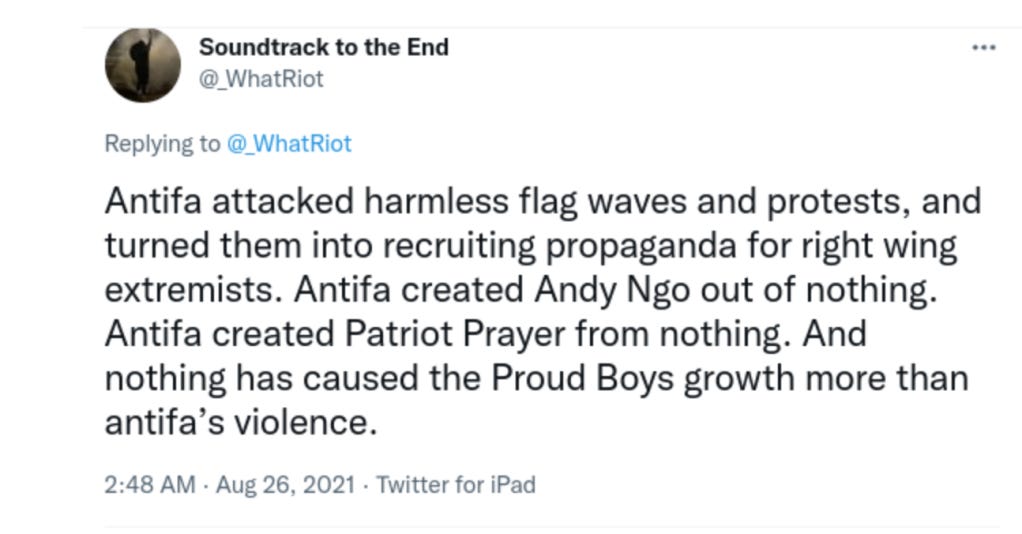
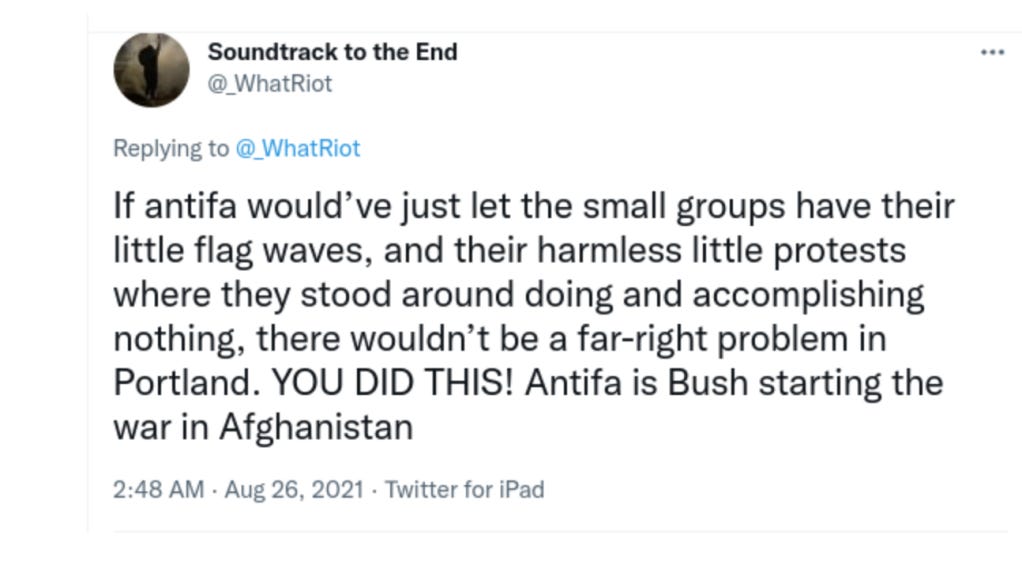
They needn’t have worried, and could not be expected to foresee the city’s law enforcement apparatus, including the despised police, would eventually step in to rescue their campaign against the right’s freedom of assembly, led by a former Republican prosecutor (Vasquez says he abandoned the party in 2017 out of disgust for Trump).
Sometime in 2020 an itinerant oil field worker from Texas named Alan Swinney travelled to Portland to join the fight. The tall, intimidating Texan soon became a familiar presence at the confrontations, despised by antifa.
On August 15 of 2020 Swinney led a small “flag wave” demonstration in front of Portland’s downtown police precinct (boarded up since the riots began that summer, and devoid of any police presence on the streets outside) that drew a larger group of counter-demonstrators.
Typically in these encounters antifa counter-demonstrators would follow the patriots after they dispersed and headed for their cars at a rally’s end, with antifa seeking out smaller vulnerable groups of patriots to attack. As they pursued Swinney’s departing handful of rallygoers he deployed bear mace at various points to back them off, for one of these he drew the assault charge of twelve he would eventually face in court. I followed and recorded the groups through most of the encounter.
Later Swinney fired paintballs at his pursuers, drawing two serious Assault II charges; the first for striking a man named Jason Britton near the eye. Britton can be heard ranting maniacally in the video below, presumably just before the “assault”.
The BLM group pursued the last of the patriots to a parking garage and harassed uninvolved motorists exiting, demanding they proclaim “black lives matter”. The woman leading that effort seen below is Demetria Hester, who gained momentary notoriety in Portland’s black activist scene after inserting herself into the trial of Jeremy Christian, who stabbed two people to death on a commuter train in 2017 in what became nationally recognized as a “hate crime” because Christian’s victims had intervened as he berated a woman in an Islamic veil. Diminutive and ferocious, Hester clashed with the mentally ill Christian the day before the killings and he blackened her eye with a thrown bottle.
August 15 2020, Dennis Dale Untethered Livestreams
Swinney drew a total of five charges for that first day, including “unlawful use of mace in the second degree” and the more serious Assault in the Second Degree charge (a “level II” crime requiring a minimum five year sentence under Oregon’s Measure 11) for the paintball strike, using a novel interpretation of a paintball gun, the use of which had been routine for both sides in the conflict, as a dangerous weapon.
A week later on August 22 a larger rally was held in the same spot in front of the boarded-up police precinct. The group was met by a much larger antifa presence this time, and again was chased out of town as they tried to leave. Swinney was on scene and drew seven more charges, including another level II Assault in the Second Degree for striking a woman on the chest with a paintball (eventually this would be the only one of the twelve charges on which a jury would not convict).
August 22 2020, Dennis Dale Untethered Livestreams
Swinney also drew an unlawful use of a weapon charge for pointing a handgun at the antifa forces. An antifa-allied journalist working for public broadcasting, Sergio Olmos, got the scalp in the form of a photograph of Swinney, covered in paint from antifa projectiles, brandishing a revolver.
Oregon state law defines Assault in the Second Degree as an act that:
(a) Intentionally or knowingly cause serious physical injury to another;
(b) Intentionally or knowingly causes physical injury to another by means of a deadly or dangerous weapon; or
(c) Recklessly causes serious physical injury to another by means of a deadly or dangerous weapon under circumstances manifesting extreme indifference to the value of human life.
Regarding the injury to Jason Britton’s eye Vasquez avoided having to prove “serious physical harm” by not calling a medical expert to testify to that fact (and denying defense the opportunity to call an expert to rebut the claim), relying entirely on the purported victims’ testimony and photographs of small bruises, one near a man’s eye and one on a woman’s breast. A jury rejected the latter charge but convicted Swinney on the first, accepting Vasquez’ novel definition of a paintball gun as a “dangerous weapon”.
An anti-police blogger, cop blaster, wrote at the time:
Other cases involving paintballs in Oregon in recent years suggest that Vasquez’s fellow prosecutors including some in his own office lack his ambition or just don’t think that paintballs are dangerous weapons. Earlier this year a man was charged with Assault IV for shooting someone with a paintball in downtown Portland (https://pamplinmedia.com/pt/9-news/…). Three years ago a teenager was charged with 25 counts including several counts of physical harassment, but no assault charges for going on a shooting spree with a paintball gun in Bend (https://www.bendbulletin.com/locals…). Had someone been convicted of Assault II just for inflicting bruises with a paintball gun before those incidents then the defendants would have likely been charged with Assault II and both of them would have faced a mandatory minimum of 5 years in prison upon conviction.
In this case Britton had his tale of suffering eye injuries to this day which defense counsel pointed out was not backed by any tangible evidence beyond his word. DDA Nathan Vasquez obviously realized that he could still use his claim to help the case anyway as long as he didn’t use it in a way that required an expert witness to back it up. That meant that he couldn’t charge Swinney with Assault II using the serious physical injury prong because that would have required proof of injury beyond a reasonable doubt, such proof can only be established with expert testimony, and the defense has a right to a rebuttal expert. Proof of Britton’s injury would have made the case a slam dunk, but instead they had to go with treating a paintball as a dangerous weapon
Cop Blaster further points out the jury accepted Swinney’s defense that he was aiming his paintball gun at someone behind Britton who was wearing a full face gas mask, but under something called “transferred intent” Oregon law treats the injury to Britton as deliberate.
A week after the August 22 clash, a Proud Boy was shot and killed for walking downtown after patriots led a car caravan through the city. Michael Reinoehl, a member of a notorious antifa “security” team that was also involved in a savage beating of a random bystander that was national news for a day; Reinoehl went into hiding and was later killed in Washington state by a joint task force of federal and local police. An apparent associate of Reinoehl’s group can be seen here at the August 22 event threatening to return with a gun:
That man was later convicted of beating his infant son to death, and is serving 12 years in prison for the crime. That’s two years more than Swinney would ultimately receive for using bear mace and a paintball gun in the August 15 and August 22 confrontations instigated by antifa.
Schmidt and Vasquez utilized a law passed by Oregon voters in 1994 requiring mandatory minimums of five years for “level II assault” (assault in the second degree), the previously mentioned Measure 11–an option the DA wouldn’t have if his testimony in favor of overturning the law less than a year before had succeeded–to draw the ten year-plus sentence of 130 months. As a proponent of restorative justice Schmidt is actively avoiding level II charges in the cases of street crime for which it’s intended; like other progressive prosecutors around the country he’s created a Justice Integrity Unit and hired an outside criminal defense attorney dedicated to reducing or expunging sentences received under Measure 11. Oregon progressives have repeatedly tried to repeal the law (here’s an example of someone who served hard time for a level II offense and soon committed a horrific murder after release) without success.
Pre-trial Swinney was held on high bail as a threat to the public and witnesses, based on social media postings and of course the association with the dreaded Proud Boys. Despite the 51 year-old having no criminal history District Attorney Schmidt’s team successfully lobbied for a lengthy prison term of consecutive sentences based on social media posts, a sympathetic letter written to Derek Chauvin where Swinney spoke of “civil war” and the usual “lack of remorse”.
Multnomah County prosecutors said Swinney’s bail shouldn’t be reduced, citing his social media posts where he’s called the conflict between right-wing and left-wing activists a “civil war” and bragged about his access to guns. He also pledged on social media that “it will be hazardous to your health” if anyone confronted him, prosecutors said.
Swinney also admitted after his arrest that he drew a Ruger 357 Magnum revolver during the Aug. 22 protest in the city, the prosecutors wrote. The Proud Boys have distanced themselves from Swinney, who has identified himself as a member and has a “Proud Boy” tattoo on his forearm.
The state is recommending 130 months prison because the defendant represents a future danger to this community and due to the gravity of his crimes. As evidenced by the defendant’s escalating violence, letters, social media statements and testimony, the defendant has no remorse for his actions, no desire to change and every intention of engaging in future acts of violence.
The defendant takes great pride in his actions and has a complete inability to recognize the criminality of his conduct. The only option to mitigate the potential risk that the defendant poses
to this community is substantial incarceration.
Meg McLain was the one of Swinney’s purported assault victims, having taken a paintball to the breast; this was the lone charge for which Swinney was not convicted. McLain in a comment thread at the anti-cop site Raindrop Works:
Meg McLain here. I’d like to mention for the people angry at me here: in both the civil and criminal trial I requested NO punishment. I agreed to zero dollars of the $250,000 he agreed to in exchange for admitting to the assault. And I requested zero jail time in relation to guilty verdict regarding him macing me (which can be considered as taken, being his other charges were given sentences that ran at the same time, and is considered already served). Despite guilty verdict and admission of guilt in a civil trial I requested AND RECEIVED zero punishments against Alan. All I ever wanted was him to recognize I wasn’t part of a political opposition group, but rather just a bystander. He instead invented a story about me to justify and glorify harming me. Yet I STILL requested nothing…
it would be entirely speculative for me to guess [why Swinney maced her]. I was leaving, thinking all the “patriot”/“trump”people had already gone. I was kneeling down to adjust my shoe, and Alan came out from behind a van and sprayed a group in all black that was yelling at him to my left. I assume he thought I was with them (tho I was about 6ft away and wearing normal clothes). I think it was just a case of bad timing on my part and lack of concern about ensuring he knew the intentions of everyone there before attacking them.
The Monday following Swinney’s sentencing another man, who also came to Portland from Texas, was sentenced to 46 months in federal prison for hitting a US Marshal with a hammer in an attempt to break into the barricaded federal courthouse. He was looking at a maximum of twenty years.
The police were nowhere in sight on the first day, August 15, and on the August 22 following they posted a block up the street periodically announcing over loudspeaker that they would not intervene, but that individuals could find themselves charged with crimes later. The combination of the city abandoning the streets and antifa’s role as aggressor prompt a question no one has seen fit to ask: how does the state justify suspending the maintenance of law and order only to return and prosecute select acts that took place in the ensuing chaos–actions taken by those who were sought out by their “victims”?
Swinney’s real crimes however were of loyalties and speech. One could provide no end of counter examples of the left anarchists’ acts of violence, expressed desires to engage in civil war against their enemies and intent to commit further and greater acts of violence, including promises to “kill”. They however are not going to find themselves facing charges in municipalities such as Portland except in the most extreme cases (or, maybe, for federal offenses). Swinney’s situation is a case study in how not to oppose antifa. This will be even more evident in the next case I’ll consider, that of the more voluble and sociable Tusitalia “Tiny” Toese, whose conviction relied even more heavily on speech and the association with (and dubious characterization of) the Proud Boys.
 untethered